Contents
- Compressors Don’t Go on the UPS: So What Does the UPS Do?
- Restarting Compressors After an Outage
- Voltage Fluctuations and Compressor Life
- What Size UPS? A Worked Example
- Battery Runtime: How Long Should Logging Last?
- Installation and Environmental Conditions
- Different Needs for Produce, Meat and Dairy, and Pharmaceutical Stores
- Frequently Asked Questions
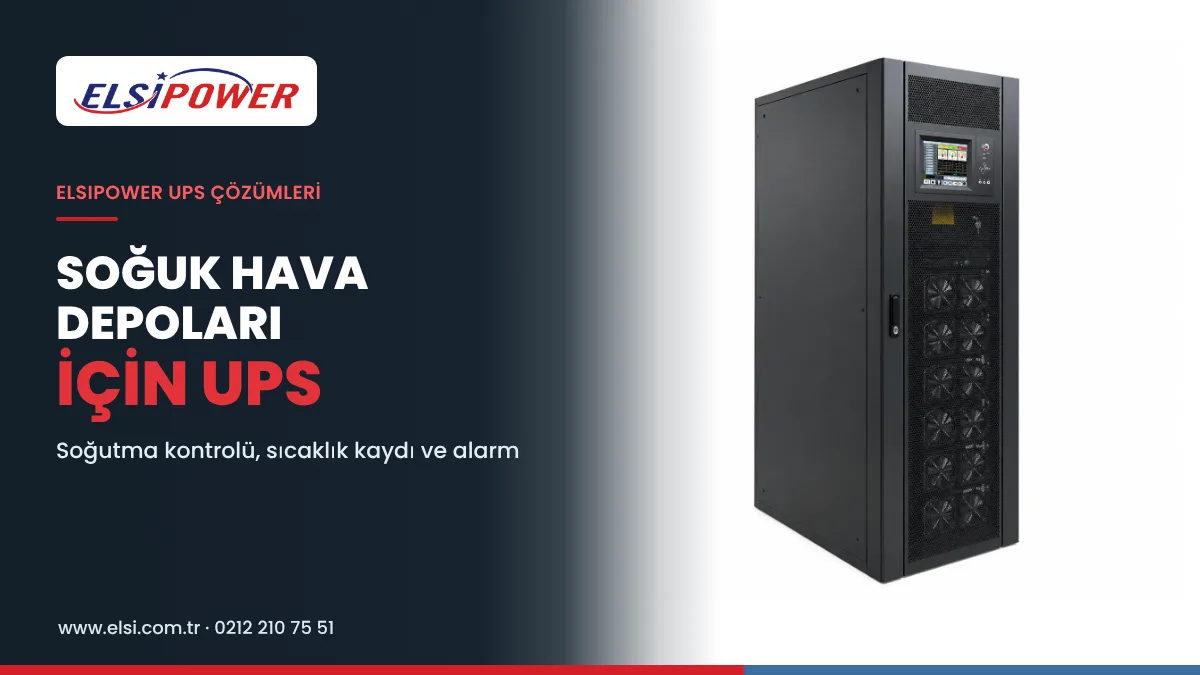
In cold storage, the cost of a power outage is measured by the value of the goods inside. Fruit and vegetables, meat and dairy, frozen food or medicines must all be kept within a certain temperature range. As an outage drags on, the temperature rises; even more importantly, if temperature is not logged during the outage, it becomes impossible to document that the product’s cold chain was not broken.
In this article we look at planning an uninterruptible power supply (UPS) for cold stores and cold-chain facilities from the point of view of compressors, control systems and temperature logging.
Compressors Don’t Go on the UPS: So What Does the UPS Do?
Refrigeration compressors, evaporator fans and defrost heaters draw high power; supplying them from a UPS is not economical. The right way to keep cooling going is a generator. The UPS protects the systems that control and record the refrigeration:
| System | Source | Why it matters |
|---|---|---|
| Refrigeration control panels and room controllers | UPS | Preserving settings and defrost programmes |
| Temperature monitoring and logging (data logger) | UPS | Continuous documentation of the cold chain |
| Alarm and GSM notification device | UPS | Instant alert on outage or temperature rise |
| Warehouse software, office PCs, network | UPS | Stock and shipment records |
| Cameras and card access | UPS | Security and access records |
| Compressors, fans, defrost heaters | Generator | High power and starting current |
Restarting Compressors After an Outage
When power returns, all compressors starting at once create a very high momentary load on the mains or generator. This can trip breakers, strain the generator and cause motor failures. When control panels are supplied by a UPS, settings and staggered start programmes are preserved, and compressors come on in a controlled sequence. If the control panel loses power, this sequence may be disrupted on some systems.
Voltage Fluctuations and Compressor Life
Cold stores are mostly located in industrial or rural areas, where voltage fluctuations are common. Low voltage makes compressor motors draw more current and overheat, while high voltage damages electronic boards. A voltage regulator at the site entry protects compressors and refrigeration equipment, while control and logging systems are supplied by an online UPS. For details, see do voltage fluctuations damage equipment.
What Size UPS? A Worked Example
| Load | Estimated power |
|---|---|
| 3 refrigeration control panels (3 × 100 W) | 300 W |
| Temperature monitoring and logging system | 150 W |
| Alarm and GSM notification | 30 W |
| Office PCs and warehouse software | 500 W |
| Network devices | 100 W |
| Camera recorder and cameras | 250 W |
| Total | 1,330 W |
1,330 W ÷ 0.9 ≈ 1.5 kVA; with a 25% safety margin ≈ 1.85 kVA. A 2–3 kVA online UPS suits this facility. If control panels are spread across the store, their supply lines should be run separately from the UPS panel.
Battery Runtime: How Long Should Logging Last?
In facilities with a generator, the UPS keeps control and logging systems running until the generator takes over; 15–20 minutes is usually enough. If there is no generator, or the generator fails, temperature logging and alarms need to continue for hours. Because these loads are small, long runtimes can be achieved economically with external batteries. See how long a UPS runs for the method.
Installation and Environmental Conditions
The UPS and batteries should be installed in a normal-temperature area such as the office or a technical room, not inside the cold rooms. Very low temperatures reduce battery capacity and condensation damages electronic boards. Dust and humidity around loading docks should also be considered. Panel layout and cabling are planned with a site survey before installation, and periodic maintenance is carried out at least once a year.
Different Needs for Produce, Meat and Dairy, and Pharmaceutical Stores
- Fruit and vegetable stores: The analysers and control systems that manage oxygen and carbon dioxide levels in controlled-atmosphere (CA) rooms should also be on the UPS. If these systems shut down, the room’s balance can be disturbed.
- Meat and dairy stores: Temperature records are requested in food safety inspections; uninterrupted operation of the logging system is a priority.
- Pharmaceutical and vaccine stores: Because of narrow temperature ranges and strict documentation requirements, logging, alarm and monitoring systems must be protected by a UPS with long battery runtime.
- Frozen food stores: Because of the low temperatures, door heaters and automatic door controls should also be included in planning.
Frequently Asked Questions
Can I run the compressor of a small cold room from a UPS?
It is technically possible for small single-phase compressor rooms, but the UPS must be oversized for the compressor’s starting current and runtime will be short. In most cases a generator is the more economical solution.
Why does temperature logging matter during an outage?
A record showing the temperature stayed within the acceptable range during the outage is how you document that the cold chain was maintained. With the logging system on the UPS, there is no gap.
How will I know about an outage when I’m not on site?
A GSM alarm on the UPS or the email notification of a UPS with a network card alerts you as soon as the outage starts.
A power plan for your cold store
Tell us the number of rooms, your control panels and logging systems; together we will plan an online UPS, battery runtime and a voltage regulator to protect your compressors. You can call us on 0212 210 75 51 or send an email to elsi@elsi.com.tr.