Contents
- What Does a Power Outage Cost a Fuel Station?
- Which Systems Should Be on the UPS?
- Which Type of UPS Suits a Fuel Station?
- What Size UPS? A Worked Example
- Battery Runtime: How Much Backup Is Needed?
- Where Should the UPS Be Installed?
- Maintenance: Why It Matters More at Stations
- Short Outages and Voltage Fluctuations
- Shop, Café and Car Wash Areas
- Fuel Station UPS Checklist
- Frequently Asked Questions
When the power fails at a fuel station, it is not just the lights that go out. Dispenser electronics can lose a sale in progress, the automation system can stop transferring data, tills and POS terminals shut down, queues grow and customers drive on to the next station. Short outages and voltage fluctuations can also damage dispenser boards and automation equipment.
In this article we explain which systems need protecting when choosing an uninterruptible power supply (UPS) for petrol and fuel stations, the right type of UPS, how to size it and what to consider during installation.
What Does a Power Outage Cost a Fuel Station?
- Interrupted sales: If dispenser electronics shut down during filling, the sale record may not complete and the meter and till may disagree.
- Automation and data loss: The automation system that collects tank levels, dispenser control and sales data stops during an outage; restarting and resynchronising takes time.
- Tills and payment systems: Cash registers, POS terminals and shop tills shut down, so card payments cannot be taken.
- Security: The camera recorder (NVR) and alarm system may stop recording during the outage.
- Hardware faults: Sudden loss and return of power can permanently damage dispenser boards and network devices.
Which Systems Should Be on the UPS?
| System | Why it matters | UPS? |
|---|---|---|
| Dispenser electronics | Completing filling and sale records | Yes, from the main UPS |
| Automation and tank gauging | Data integrity and continuous monitoring | Yes, from the main UPS |
| Tills, POS, cash registers | Taking payments | Yes |
| Modem, switch, internet | Card payments and data transfer | Yes |
| Camera recorder (NVR) and alarm | Continuous security recording | Yes |
| Submersible pump motors | High starting current | No, supplied by the generator |
| Canopy and forecourt lighting | Large, continuous load | Usually from the generator; emergency lighting planned separately |
The rule is simple: electronics and data systems go on the UPS, motors and large lighting loads go on the generator. The UPS keeps the electronics running without a single interruption until the generator takes over. We explain how the two work together in our article on UPS and generator compatibility.
Which Type of UPS Suits a Fuel Station?
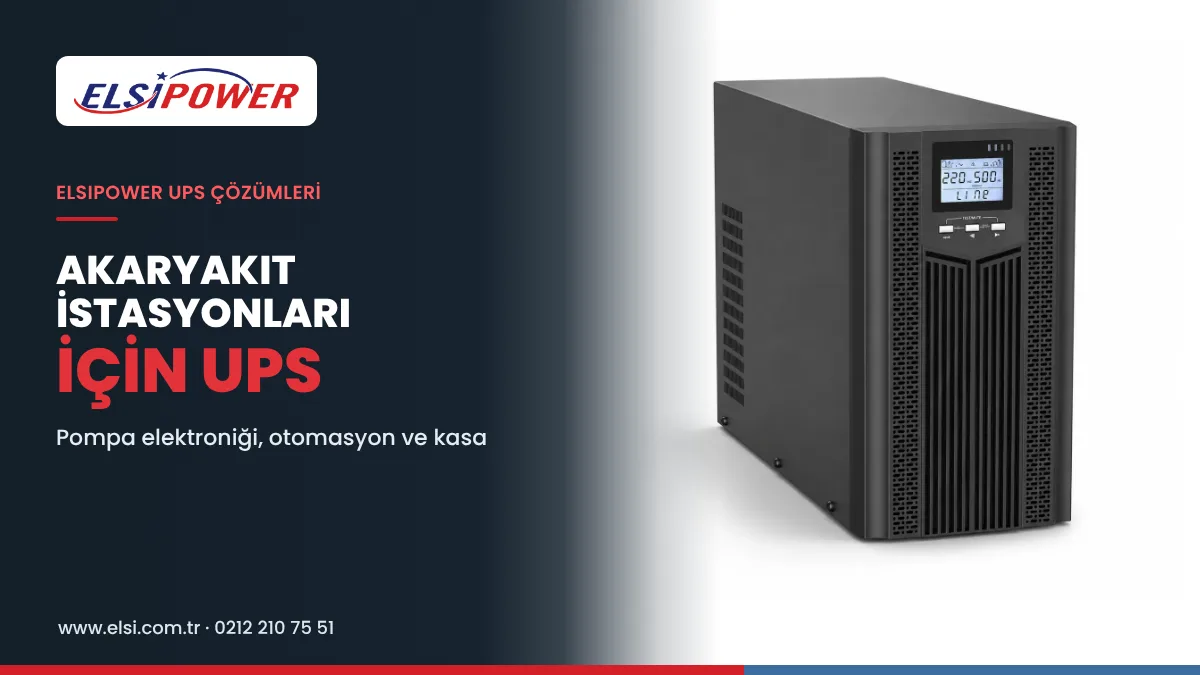
Mains supply at stations is often unstable and generators are commonly used. An online (double-conversion) UPS, whose pure sine-wave output is fully independent of the mains, is therefore the right choice. It also filters out generator frequency and voltage fluctuations, so dispenser electronics and automation equipment run on clean power.
- Small and medium stations: A 3–10 kVA single-phase online UPS is usually sufficient.
- Large stations and service areas: If the shop, café and service areas are also to be supplied, a three-phase online UPS is considered.
What Size UPS? A Worked Example
| Load | Estimated power |
|---|---|
| 4 dispenser electronics (4 × 150 W) | 600 W |
| Automation PC and tank gauging | 400 W |
| 2 tills / POS (2 × 150 W) | 300 W |
| Modem and switch | 100 W |
| Camera recorder and cameras | 200 W |
| Total | 1,600 W |
1,600 W ÷ 0.9 ≈ 1.8 kVA; with a 25% safety margin ≈ 2.2 kVA. A 3 kVA online UPS is a good starting point for this station. The values are examples; the actual load is determined from rating plates or on-site measurement.
Battery Runtime: How Much Backup Is Needed?
If the station has a generator, the UPS only has to keep systems running until the generator starts and stabilises (usually a few minutes); 10–15 minutes of battery time is often enough. Without a generator, a longer runtime is planned so that sales can be closed and data saved safely, and external battery cabinets are added. See our article on how long a UPS runs for the calculation method.
Where Should the UPS Be Installed?
At fuel stations, the filling area and tank surroundings carry an explosive-atmosphere risk. The UPS and batteries must be located outside these hazardous areas, in a suitably ventilated electrical room or office area. The installation location, cabling and earthing are determined by the site’s electrical design and the applicable regulations, which is why a site survey and design before installation matters.
Maintenance: Why It Matters More at Stations
Fuel stations run around the clock and the UPS is always in service. Dust, high temperatures and frequent generator transfers can shorten battery life. Periodic maintenance at least once a year checks battery capacity, fans, connections and alarm functions. Our UPS technical service and maintenance keeps the UPS at your station ready at all times.
Short Outages and Voltage Fluctuations
At fuel stations, the problem is often not long outages but short interruptions and voltage dips that occur many times a day. A half-second loss of mains may go unnoticed by people, but for dispenser control boards and the automation PC it means a restart. Each restart brings the risk of incomplete sale records and synchronisation errors. An online UPS hides these short interruptions completely; the equipment never notices what happens on the mains.
Voltage dips are especially common in the evenings and at stations near busy industrial areas. Electronic boards running at low voltage heat up and their lifespan shortens. If the whole site has a constant voltage problem, adding a voltage regulator ahead of the UPS can also be considered.
Shop, Café and Car Wash Areas
Many modern stations also have a shop, café, car wash and tyre service. The tills and payment systems in these areas can be supplied from the same UPS as the dispenser automation or protected by separate small UPS units. When deciding:
- Shop tills and POS terminals can usually be added to the main UPS circuit and must be included in the total load calculation.
- High-power loads such as refrigerated cabinets, coffee machines and car wash pumps are not put on the UPS but supplied from the generator.
- If the café and shop are in a separate building, cable distances and panel layout may make two separate UPS units more sensible than one.
It is important that UPS capacity can grow as the station grows. Leaving a 20–30% expansion margin at the initial installation avoids having to replace the UPS later.
Fuel Station UPS Checklist
- Are dispenser electronics, automation, tills, network and cameras on the UPS circuit?
- Have motors and large lighting loads been separated from the UPS circuit?
- Is the UPS an online type compatible with the generator?
- Are the UPS and batteries outside hazardous areas, in a ventilated room?
- Does battery runtime cover the generator transfer or a safe shutdown?
- Are annual maintenance and battery tests scheduled?
Frequently Asked Questions
Can I connect the pump motors to the UPS?
It is not recommended. Submersible pump motors draw a high starting current and would require a very large UPS. Motors should be supplied by the generator, dispenser electronics and automation by the UPS.
Is a line-interactive UPS enough?
It may be enough for a single till or modem, but for the main UPS supplying dispenser electronics and automation, an online UPS that works smoothly with generators is safer.
Could the batteries in our existing UPS be worn out?
UPS batteries usually weaken within 3–5 years depending on conditions. If your UPS runs for less time than expected during an outage, you should have the batteries tested.
Which panel is the station UPS connected to?
The UPS is installed to distribute power to the critical loads through a separate UPS output panel. This makes it clear which systems are on the UPS and prevents large loads from being added by mistake later.
What happens to the sale at the dispenser during an outage?
If dispenser electronics and automation are on the UPS, the electronics keep running and the sale record is preserved. If the submersible pump is not supplied by the generator, fuel flow stops, but meter and sale data are not lost.
Let’s choose the right UPS for your station
Tell us the number of dispensers and the systems to be protected, and we will recommend a suitable online UPS and battery configuration and plan installation and maintenance with you. You can call us on 0212 210 75 51 or send an email to elsi@elsi.com.tr.