Contents
- Laboratory Equipment That Should Be Protected by a UPS
- Why an Online UPS?
- What Size UPS? A Worked Example
- A Separate Plan for Freezers
- Accreditation and Continuity
- Installation and Maintenance
- Needs by Laboratory Type
- Why Power Quality Matters in the Laboratory
- Determining Battery Runtime
- Frequently Asked Questions
In laboratories, the cost of a power outage is not measured only by the instruments that stop. An interrupted analysis, a PCR run lasting hours or a sample freezer warming up means repeated tests, lost samples and delayed results. Sensitive analytical instruments are also highly susceptible to voltage fluctuations, harmonics and sudden power loss.
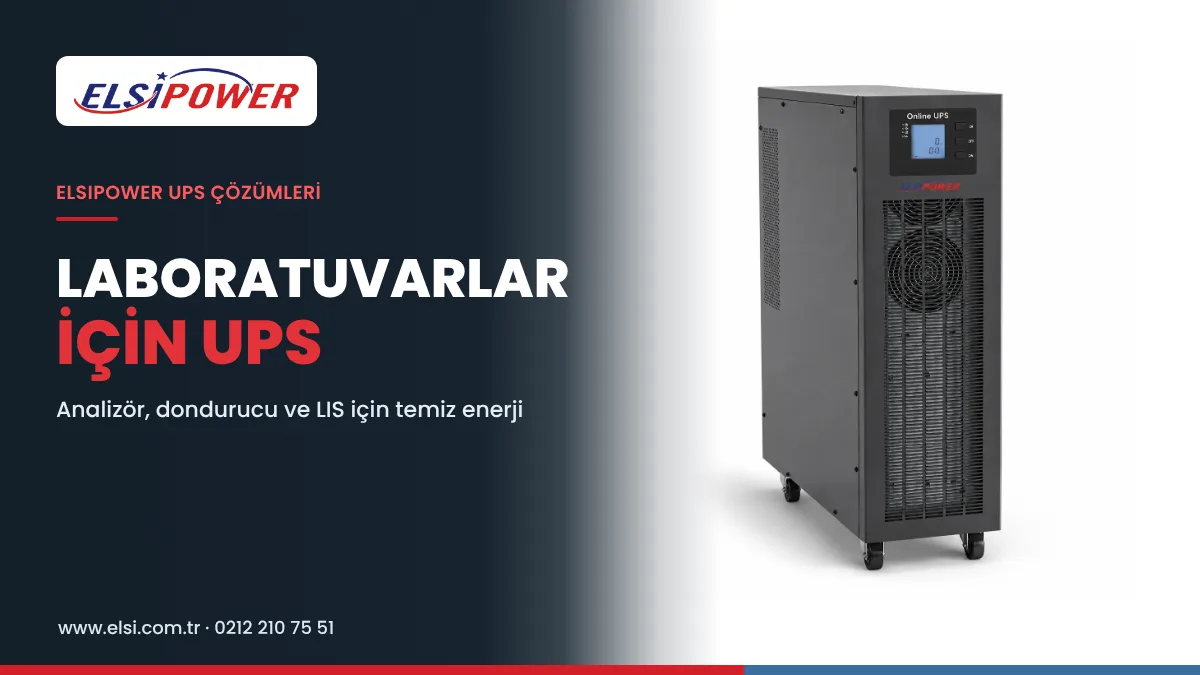
In this article we share the key points when choosing an uninterruptible power supply (UPS) for medical, food, environmental, quality-control and R&D laboratories, along with a worked sizing example.
Laboratory Equipment That Should Be Protected by a UPS
| Equipment / system | Effect of an outage |
|---|---|
| Biochemistry, hormone and haematology analysers | Running tests are cancelled, reagents lost |
| PCR and molecular testing instruments | Cycles lasting hours are interrupted |
| -80 °C freezers and sample fridges | Risk of sample and reagent spoilage |
| Chromatography, spectrometry and similar | Corrupted measurements, calibration problems |
| Laboratory information system (LIS) and server | Sample tracking and result transfer stop |
| Incubators and biosafety cabinets | Cultures and working safety are affected |
Which equipment goes on the UPS is decided by considering the manufacturer’s power requirements together with the laboratory’s workflow. High-power heating equipment such as ovens, autoclaves and furnaces is usually backed up by the generator rather than the UPS.
Why an Online UPS?
Laboratory instruments are affected not only by outages but also by power quality. An online (double-conversion) UPS converts mains power first to DC and then to clean, stable AC. As a result:
- There is no transfer time during an outage; instruments never shut down.
- Voltage dips, surges and frequency fluctuations do not reach the instruments.
- Unstable power while the generator starts is filtered out.
We explain the difference between UPS types in detail in online vs line-interactive UPS.
What Size UPS? A Worked Example
| Load | Estimated power |
|---|---|
| Biochemistry analyser | 1,500 W |
| PCR instrument | 600 W |
| -80 °C freezer (running) | 700 W |
| LIS server and network | 360 W |
| 2 computers | 200 W |
| Total | 3,360 W |
3,360 W ÷ 0.9 ≈ 3.7 kVA; with a 25% safety margin ≈ 4.7 kVA. A 6 kVA online UPS is a suitable starting point for this laboratory. The freezer compressor’s starting current and the inrush current of analysers are also considered when selecting the UPS. Larger laboratories are supplied by a three-phase online UPS; where capacity will grow over time, a modular UPS provides flexibility.
A Separate Plan for Freezers
-80 °C freezers holding valuable samples are the equipment least tolerant of outages. For these freezers:
- A separate UPS and a long-runtime external battery bank can be planned.
- If there is a generator, the UPS bridges the gap until it takes over.
- Temperature alarms and UPS alarms should be set up for remote monitoring.
Accreditation and Continuity
In accredited laboratories, environmental conditions and power continuity for equipment are recorded. UPS units with network monitoring cards can support these processes by logging outages and alarms. Periodic maintenance and battery test records for the UPS should also be kept regularly.
Installation and Maintenance
The right UPS capacity is determined by measuring the actual consumption of laboratory equipment on site. At ELSIPOWER we provide site survey and design, installation and 24/7 technical service. To find out when batteries should be replaced, see when should UPS batteries be replaced.
Needs by Laboratory Type
- Medical testing laboratories: Analysers, centrifuges, sample fridges and LIS. Because timely results are critical, continuity is the priority.
- Food and water testing laboratories: Incubators, chromatography instruments and sample storage cabinets. The aim is that long incubations and analyses are not interrupted.
- Quality-control laboratories (in factories): Measuring instruments and test rigs. Fluctuations from heavy factory loads can affect measurement accuracy; an online UPS removes this effect.
- University and R&D laboratories: Long-running experiments, data-acquisition computers and valuable samples. Repeating an experiment that took weeks because of an outage is a serious loss of time.
Why Power Quality Matters in the Laboratory
Analytical instruments work with millivolt-level signals. Voltage spikes, harmonics and electrical noise on the mains can cause deviations in results, instrument error codes and calibration drift. The effect is more pronounced when the building also has lifts, air-handling units or large motors. An online UPS isolates instruments from the mains and always supplies power of the same quality. It is an investment not only against outages but also in measurement reliability.
Determining Battery Runtime
In laboratories, battery runtime is set according to the longest critical process. For example, the aim may be to complete a PCR cycle safely or to supply a freezer until the generator takes over. Where there is a generator, 10–15 minutes is usually enough; laboratories without a generator may need a battery bank lasting hours for freezers. See how long a UPS runs for the method.
Frequently Asked Questions
Should we use a separate UPS for each analyser?
In small laboratories a UPS per instrument can be practical, but as the number of instruments grows, a central online UPS makes monitoring, battery maintenance and load management easier.
My analyser alarms when it is on the UPS. Why?
The UPS capacity may not cover the instrument’s inrush current, or the battery may be weak. A load measurement and battery test can identify the cause.
Isn’t a generator enough for a laboratory?
There is an interruption of several seconds before the generator takes over, and power is unstable in the first moments. A UPS covers this gap and the fluctuations for sensitive equipment.
Should we put centrifuges on the UPS?
Centrifuges draw a high current when starting. Those used for critical processes can be connected with UPS capacity sized accordingly; others can be left off the UPS.
Is it possible to rent a UPS for a laboratory?
For relocations, refurbishments or temporary installations, you can consider our UPS rental option.
A UPS solution for your laboratory
Send us your equipment list and the areas you want to protect; we will carry out a load analysis and plan the online UPS capacity, battery runtime and the best set-up for your freezers with you. You can call us on 0212 210 75 51 or send an email to elsi@elsi.com.tr.