Kesintisiz Güç Kaynağı (UPS) Nedir? Ne İşe Yarar? 2026 Maliyetleri
Kesintisiz Güç Kaynakları (UPS) Nedir? Ne İşe Yarar? Kurulum ve Kullanım Rehberi
1 Ocak
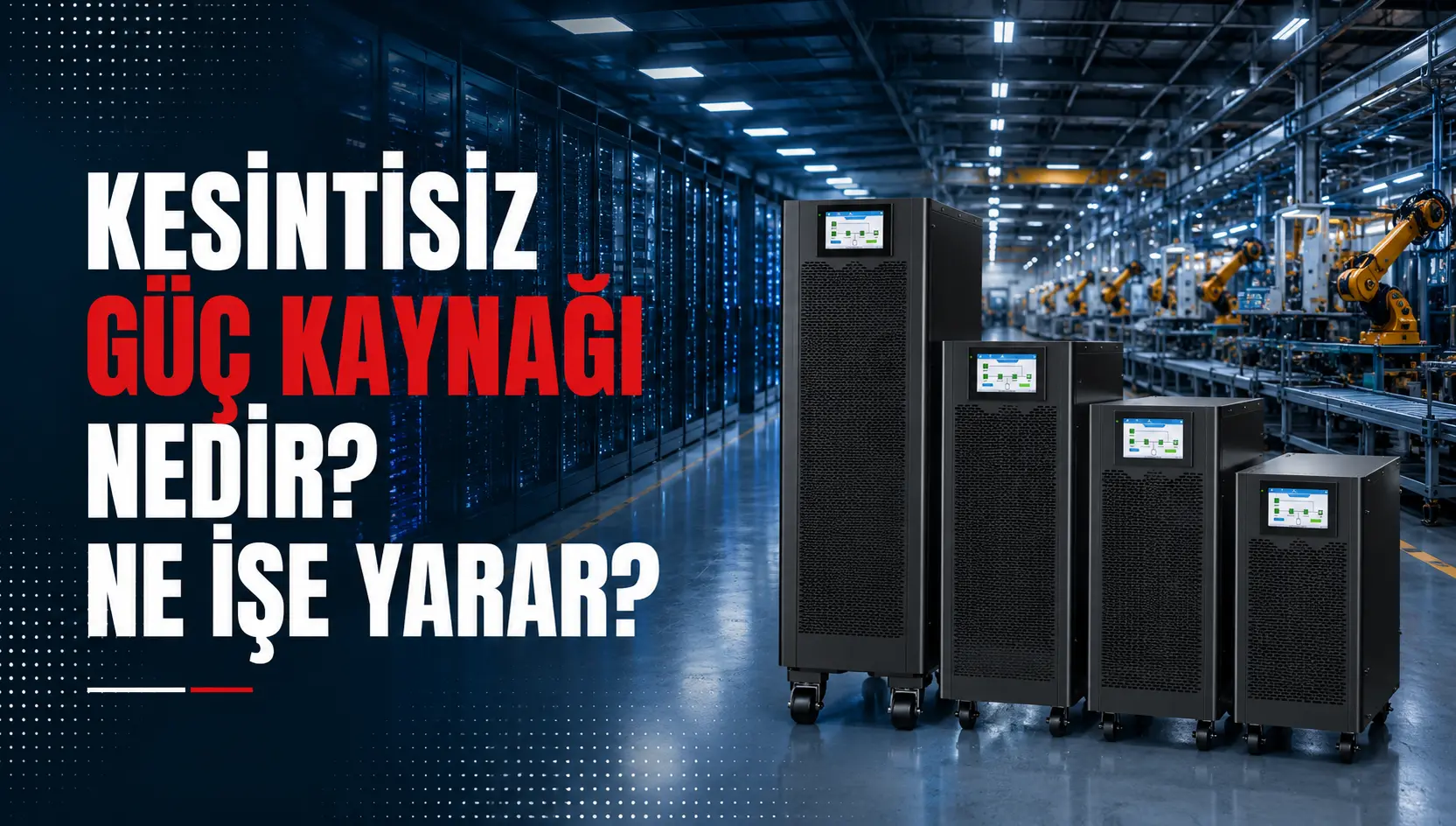
What Is an Uninterruptible Power Supply (UPS)? Where Is It Used and Which Type Should You Choose?
An uninterruptible power supply (UPS) is a power protection system that supplies battery power to connected equipment when the mains electricity fails. It can also help protect equipment against voltage fluctuations and other power-quality problems. UPS systems are used in applications ranging from computers and server rooms to hospitals and factories. Choosing the right UPS is not simply a matter of asking “how many kVA?” The load characteristics, required runtime, phase configuration, future expansion and service conditions must all be considered.
In this guide, we explain what a UPS is, what it does, how it works, where it is used, which UPS should be selected and what determines uninterruptible power supply prices in 2026—in clear, practical language.
If you would like help calculating the right capacity and selecting a suitable system, contact the Elsipower Uninterruptible Power Supply team on +90 212 210 75 51 or send your load list to elsi@elsi.com.tr.
What Is an Uninterruptible Power Supply and What Does It Do?
UPS stands for Uninterruptible Power Supply. A UPS charges its batteries while mains power is available and, depending on its topology, supplies the connected load either directly or through its power-electronic components. When a power failure occurs, it converts stored battery energy into alternating current that the equipment can use. This transfer happens very quickly—or with no transfer time in an online UPS—so connected systems can continue operating.
A UPS does more than provide a few minutes of power during an outage. When the appropriate technology is selected, it can reduce the effects of undervoltage, overvoltage, sudden voltage changes, frequency variations and electrical noise. This helps lower the risk of data loss, uncontrolled shutdowns, production stoppages and damage to sensitive electronic boards.
Are a UPS and a generator the same thing?
No. A UPS supports the critical load immediately when mains power fails. A generator produces energy from fuel for longer periods but may require time to start and stabilise. In critical facilities, the UPS supplies the load until the generator starts and produces a stable output. Even a business with a generator may therefore need a correctly sized, generator-compatible UPS.
How Does a UPS Work?
A typical UPS contains a rectifier/charger, battery bank, inverter, static bypass and control units. The rectifier converts incoming AC power into DC; the batteries store energy; and the inverter converts DC back into AC for the load. During an overload or under certain fault conditions, the static bypass can help transfer the load to a suitable mains source.
The exact operating method changes according to the UPS topology. Two units with a similar appearance and VA rating may therefore offer very different levels of protection for critical equipment.
Online, Line-Interactive and Offline UPS: What Is the Difference?
What is an online UPS?
An online double-conversion UPS normally supplies the load through its inverter. Incoming power is converted first to DC and then back to AC. As a result, there is no transfer time when the mains fails. Online UPS systems are generally preferred for servers, data centres, medical equipment, industrial automation, security systems and business processes where interruption cannot be tolerated.
What is a line-interactive UPS?
A line-interactive UPS can regulate certain voltage fluctuations without using its batteries. During a power failure, the inverter takes over and a short transfer time occurs. It can be an economical option for moderately critical loads such as desktop computers, small offices, modems and some network equipment.
What is an offline UPS?
A standby or offline UPS normally supplies the load largely from the mains and switches to its battery-inverter circuit during an outage. It can be used for low-power applications requiring basic protection. For sensitive, expensive or operationally critical equipment, power-quality requirements and transfer time must be examined carefully.
| UPS type | Main characteristic | Typical application |
|---|---|---|
| Online UPS | Double conversion and continuous inverter supply | Servers, hospitals, factories and data centres |
| Line-interactive UPS | Voltage regulation and economical protection | Small offices, computers and network equipment |
| Offline UPS | Basic protection against outages | Low-power, non-critical loads |
This table provides general guidance. The final selection must be based on load characteristics, manufacturer specifications and site conditions.
Where Are Uninterruptible Power Supplies Used?
A UPS can be used wherever a power failure could cause data loss, a safety risk, disruption to services or a production stoppage:
- Factories and manufacturing plants: PLCs, automation panels, CNC machines, robotic lines and process-control systems
- Data centres and server rooms: Servers, storage systems, switches, routers and communications infrastructure
- Hospitals and healthcare facilities: Critical medical and IT systems, subject to the applicable standards and proper system design
- Banks and financial institutions: Transaction, communication, security and data infrastructure
- Offices and businesses: Computers, modems, telephone systems, cameras and access-control equipment
- Telecommunications: Base stations, communication systems and network equipment
- Shops, hotels and restaurants: POS, automation, reservation and security systems
- Public bodies and educational institutions: IT, laboratory and communications infrastructure
What is a roller shutter power supply?
A roller shutter power supply is a specialised backup system designed to open and close motorised shutters during a power outage. It does not have exactly the same operating purpose or conditions as a standard computer UPS. The motor’s starting current, control arrangement and required number of opening and closing cycles must be considered. It is used in shops, warehouses, garages and workplaces to maintain access during an outage.
Which Uninterruptible Power Supply Should You Choose?
There is no single brand or model that answers the question “Which is the best UPS?” The best solution is one that protects the connected equipment at the correct capacity and for the required runtime, while providing good efficiency, dependable service support and room for growth. Consider the following information together:
- Load list: Determine the active power (W/kW), apparent power (VA/kVA), power factor and starting current of all connected equipment.
- UPS technology: Online double-conversion systems are generally assessed for critical loads; line-interactive or offline technology may be suitable for more basic applications.
- Single-phase or three-phase configuration: Select a 1/1, 3/1 or 3/3-phase UPS according to the mains connection and load distribution.
- Required backup time: Decide whether the system needs only a few minutes for a safe shutdown, support until a generator starts, or an extended runtime.
- Battery configuration: Consider internal or external batteries, battery technology, ambient temperature and the future replacement cost.
- Redundancy: Parallel operation, N+1 redundancy or a modular UPS may be appropriate for critical facilities.
- Communication and monitoring: SNMP, remote monitoring, dry contacts and building-management-system integration may be required.
- Service support: Commissioning, spare-parts availability, UPS technical service, battery replacement and periodic maintenance should form part of the purchase decision.
Which UPS should you buy for a home or computer?
The wattage printed on a computer’s internal power-supply unit does not by itself show the computer’s actual consumption. The real total consumption of the computer, monitor, modem and any other equipment to be backed up should be measured or calculated with a suitable margin. For computers with active PFC power supplies, the UPS output waveform and compatibility should also be checked.
Which UPS should you buy for a server or business?
Server and network installations generally require an online UPS, adequate expansion capacity, a management card and controlled-shutdown support. In manufacturing plants, starting currents and the harmonic behaviour of motors, drives, transformers and non-linear loads require separate evaluation. A site survey and measurements are more reliable than selecting capacity online for these projects.
How Is UPS Capacity Calculated? How Many kVA Do You Need?
UPS capacity is expressed in VA or kVA, while the equipment’s real power consumption is usually stated in W or kW. In a simplified calculation, apparent power is active power divided by power factor:
Apparent power (kVA) = Active power (kW) / Power factor
For example, a load consuming 8 kW does not automatically require an 8 kVA UPS. The UPS output power factor, load type, peak current, planned additions, ambient temperature and manufacturer operating limits must be considered. A suitable growth and safety margin is then applied according to the application. An unnecessarily oversized UPS is not always beneficial because it may increase the initial investment, reduce efficiency at light load and raise battery costs.
From smaller systems to industrial projects, Elsipower evaluates requirements for 10 kVA, 20 kVA, 40 kVA, 60 kVA, 80 kVA, 120 kVA, 200 kVA, 400 kVA, 600 kVA, 800 kVA and 1000 kVA UPS systems by considering the load profile, phase configuration, runtime and operating conditions together. In high-power installations, a parallel or modular architecture may be more important than the capacity of one standalone unit.
How Long Will a UPS Run? How Is Battery Runtime Determined?
A UPS does not have one fixed runtime. The same system runs longer at a light load and for less time at a heavy load. Battery quantity and capacity, battery age, ambient temperature, inverter efficiency, discharge characteristics and the connected load all have a direct effect.
Published runtimes are based on specific test conditions. For a realistic site estimate, manufacturer runtime tables at the relevant load percentage and battery discharge data should be used. Where extended backup is required, an external battery cabinet, a higher-capacity battery bank or coordinated UPS-generator operation may be considered.
How many years does a UPS battery last?
Battery life depends on the battery type, frequency of use, depth of discharge, charging system and, in particular, ambient temperature. The expression “maintenance-free battery” does not mean that the battery never needs inspection. Voltage, internal resistance, connections, signs of swelling or leakage and available capacity should be checked regularly. One weak battery can affect the performance of an entire series-connected battery string.
What Determines Uninterruptible Power Supply Prices in 2026?
Uninterruptible power supply prices in 2026 should not be compared solely by kVA rating. Two UPS systems with the same stated capacity can have different prices because of their topology, output power factor, battery runtime, phase configuration, efficiency, communications options, parallel capability, warranty and service coverage.
The main factors affecting UPS price include:
- UPS capacity and actual kW output
- Online, line-interactive or offline topology
- Single-phase or three-phase input and output
- Internal or external batteries and the required runtime
- Modular, parallel or N+1 redundant architecture
- SNMP card, remote monitoring and communication options
- Installation, cabling, switchgear, transport and commissioning
- Warranty, maintenance agreement and after-sales technical support
When requesting a quotation, it is better to provide the total load, equipment types, phase information, required battery runtime and installation location than simply ask for a “20 kVA UPS price.” For current UPS pricing and a project-specific Elsipower quotation, call +90 212 210 75 51 or email elsi@elsi.com.tr.
Why Are UPS Technical Service, Maintenance and Periodic Maintenance Important?
A lit UPS display does not guarantee that the system will provide the expected runtime during an outage. Fans, capacitors, batteries, power modules and connections are affected by operating time and environmental conditions. Regular UPS maintenance helps identify risks before a failure occurs and keeps the system prepared for an outage.
Depending on the model and site conditions, professional UPS periodic maintenance may include general cleaning, fan inspection, battery-voltage and connection checks, alarm-log review, input/output measurements, bypass checks, load assessment, thermal inspection and appropriate testing. The maintenance interval should be based on the criticality of the facility, dust and temperature conditions, equipment age and operating load.
When choosing a UPS technical service provider, consider more than the emergency call-out charge. Accurate diagnosis, spare-parts access, maintenance reporting, battery testing, commissioning expertise and experience with high-power systems also matter. For critical loads, the way power continuity will be maintained during service should be planned in advance.
UPS solutions in Istanbul and throughout Türkiye
Based in Beylikdüzü, Elsipower evaluates UPS sales, engineering and service requests from businesses in Avcılar, Esenyurt, Büyükçekmece, Küçükçekmece, Başakşehir, Bağcılar, Bakırköy, Şişli, Kağıthane, Ümraniye, Ataşehir, Kadıköy, Kartal, Pendik and Tuzla, as well as other districts of Istanbul. Project scope and site requirements for Ankara, İzmir, Bursa, Kocaeli, Tekirdağ, Sakarya, Konya, Antalya, Adana, Mersin, Gaziantep, Kayseri, Eskişehir, Samsun and locations throughout Türkiye are planned according to each request.
For a new UPS, capacity review of an existing system, battery replacement, UPS maintenance or technical service, contact the Elsipower team on +90 212 210 75 51 or at elsi@elsi.com.tr.
Frequently Asked Questions About Uninterruptible Power Supplies
1. What does an uninterruptible power supply do?
It supplies battery power to connected equipment during a mains failure. With the correct UPS topology, it can also help protect against voltage and power-quality problems.
2. What does UPS stand for?
UPS stands for Uninterruptible Power Supply.
3. Should I choose an online or line-interactive UPS?
An online UPS is generally preferred for servers, hospitals, manufacturing and critical business loads. Subject to compatibility checks, a line-interactive UPS may be sufficient for small offices and less critical equipment.
4. How many minutes will a UPS run?
Runtime depends on the load, battery capacity, battery age, temperature and system efficiency. The actual load and manufacturer runtime tables should be evaluated together.
5. How many kVA should my UPS be?
Calculate the real consumption, power factor and starting current of all loads, then consider future growth. Simply adding equipment label values may produce an incorrect result in some applications.
6. Does a UPS increase electricity consumption?
A UPS has conversion and standby losses. Consumption varies with efficiency and load ratio. A high-efficiency, correctly sized system helps reduce unnecessary energy loss.
7. When should UPS batteries be replaced?
Replacement decisions should consider capacity tests, internal resistance, voltage balance, ambient temperature and actual runtime—not calendar age alone.
8. Can a printer or motor be connected to a UPS?
Laser printers, motors and pumps can draw high starting or peak current. They should not be connected unless the UPS inverter and peak-current capacity are suitable; consult the manufacturer or a qualified specialist.
9. How often should a UPS be maintained?
There is no universal interval. A maintenance plan should follow manufacturer guidance and account for equipment age, environmental conditions and the facility’s criticality.
10. What information is required for a UPS quotation?
Provide the load list, total kW/kVA, input/output phase configuration, required runtime, generator information, installation location, communication requirements and redundancy expectations.
Share