Contents
- What Does Ah (Ampere-Hour) Mean?
- What to Check Before Fitting a 9 Ah Battery
- The Golden Rule for UPS Units with Multiple Batteries
- What Changes When You Fit a 9 Ah Battery?
- When Is Another Solution Needed Instead of 9 Ah?
- Things to Watch When Replacing Batteries
- Which Battery Should I Choose?
- How to Read a Battery Label
- Tips to Extend Battery Life
- Frequently Asked Questions
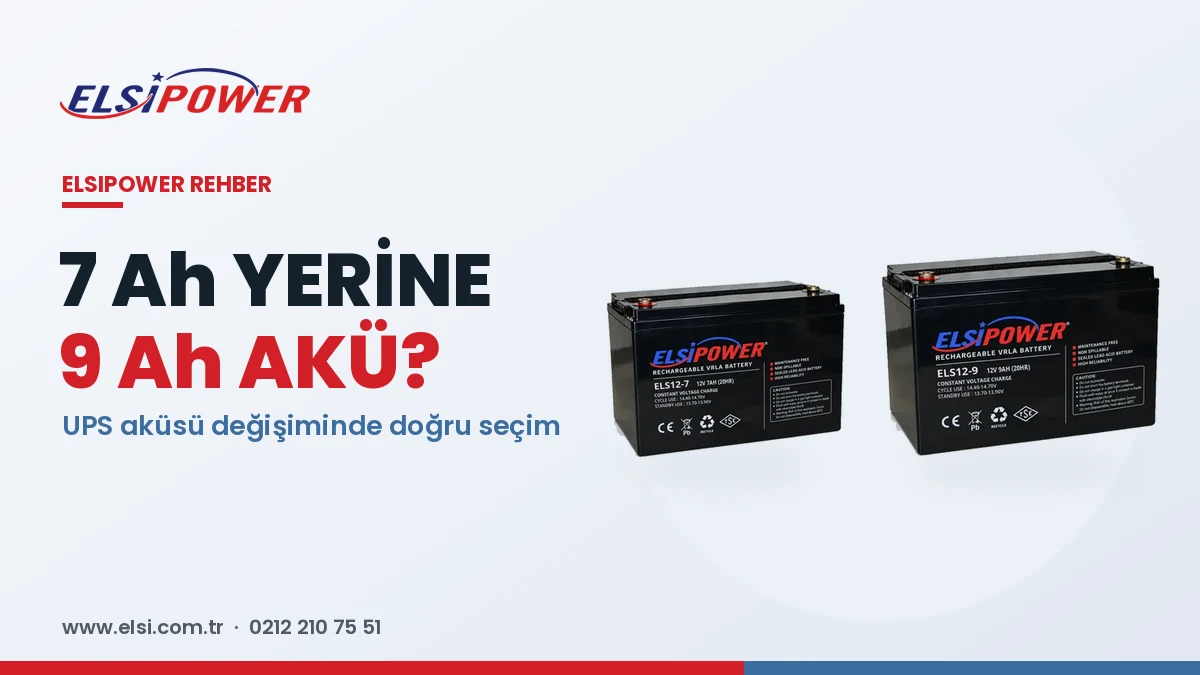
When it is time to replace UPS batteries, one of the first questions that comes to mind is: “Can I fit a 9 Ah battery instead of a 7 Ah battery in my UPS?” Many users who want longer backup time would like to use a battery of the same size but higher capacity. The short answer: Yes, it can be fitted when the right conditions are met, and in most cases your UPS will run longer during an outage.
However, there are some important points you should know before making this change. In this guide we explain in plain language when using a 9 Ah battery instead of a 7 Ah one is appropriate, what to watch out for, and in which situations this change can cause problems.
What Does Ah (Ampere-Hour) Mean?
The Ah value on a battery shows how much energy the battery can store. Of two batteries with the same voltage, the one with the higher Ah value can supply the same load for longer. So a 12V 9Ah battery runs your equipment longer during an outage than a 12V 7Ah battery.
The point not to confuse here is this: the Ah value affects runtime, not voltage (volts). The value that really matters for the UPS to work is the battery voltage. That is why, when choosing a battery, voltage is considered first and capacity second.
What to Check Before Fitting a 9 Ah Battery
Using a 9 Ah battery instead of a 7 Ah battery is fine for most small UPS units; however, all of the following conditions must be met.
| Check | Why it matters |
|---|---|
| Voltage must be the same (e.g. 12V for 12V) | A different voltage damages the UPS charging and inverter circuits |
| Battery type must be the same (VRLA / AGM) | Charging characteristics depend on battery type |
| Physical dimensions must fit the battery compartment | The battery should sit without being forced and without straining cables |
| Terminal type must be compatible | If the connector does not match, a safe connection is not possible |
| All batteries in the string must be identical | Mixed capacities upset the balance of the string |
1. The voltage must be the same
Most small UPS units use 12V batteries. If your 7 Ah battery is 12V, your new battery must also be 12V. Capacity can increase; voltage must not change. Fitting a battery with a different voltage can permanently damage the UPS.
2. The battery type must stay the same
UPS systems generally use maintenance-free sealed (VRLA / AGM) batteries. The UPS charging circuit is set for this battery type. Even at the same capacity, do not use a battery of a different technology, such as gel or lithium, unless you are sure the UPS manufacturer supports it.
3. Physical size and terminal type must be compatible
12V 7 Ah and 9 Ah batteries are often produced in the same case size, which makes the swap easy. Still, before buying, compare the length, width and height of the battery with your current one. Terminal type also matters: if the connectors differ, the cable ends will not fit and there is a risk of a loose connection.
The Golden Rule for UPS Units with Multiple Batteries
Many UPS units use their batteries as a series-connected string. In such units the most important rule is: all batteries in the string must have the same capacity, the same type and the same age.
For example, in a UPS with two batteries, using one 7 Ah and one 9 Ah battery is not correct. Batteries with different capacities do not charge and discharge at the same rate; the weaker battery wears out faster and shortens the life of the whole string. So if you move to 9 Ah, you should replace all batteries in the string together.
The same rule applies to strings where only one battery has weakened: replacing the whole string instead of a single battery is both safer and more economical in the long run.
What Changes When You Fit a 9 Ah Battery?
Backup time increases
This is the most noticeable difference. At the same load, a higher-capacity battery lets the UPS run longer during an outage. The actual time depends on the power of the connected equipment, the quality of the battery and the ambient temperature. We explain the factors that affect backup time in detail in our guide how long does a UPS run.
Charging time increases
The charging circuit of small UPS units works with a fixed current. When a higher-capacity battery is fitted, the UPS still charges it, but reaching full charge takes longer. This is usually not a problem; you just need to give the unit a little more time for the first charge after fitting the new battery. In places where outages are very frequent, however, the battery may not be fully charged between one outage and the next.
The UPS power rating does not change
A common misconception is that fitting a larger battery means you can connect more equipment to the UPS. It does not. The load a UPS can carry is limited by its VA / W rating. Battery capacity only determines how long that load can be supplied.
When Is Another Solution Needed Instead of 9 Ah?
A larger battery does not meet every need. In the following cases a different solution may be more appropriate:
- If much longer backup time is needed: A UPS model that accepts external batteries or a battery cabinet should be preferred.
- If the UPS is constantly running at its limit: Rather than a bigger battery, a higher-capacity UPS is needed.
- If critical equipment is being protected: For servers, medical devices or automation systems, an online UPS with a properly sized battery string is a safer solution.
- If the UPS itself is old: Fitting new batteries to a very old unit does not remove the risk of board or charging circuit failure.
Things to Watch When Replacing Batteries
- Before replacing, turn off connected equipment and switch the UPS off both at the mains and with its own switch.
- Note or photograph the connection order of the old battery.
- Connect the terminals to the correct poles; reversed polarity can cause serious faults.
- After fitting the new battery, leave the UPS on mains for a while to fully charge the batteries.
- Do not throw old batteries in the bin; take them to a recycling point.
Because high DC voltage may be present in high-power UPS units and battery strings, we recommend having the replacement done by authorised technical personnel.
Which Battery Should I Choose?
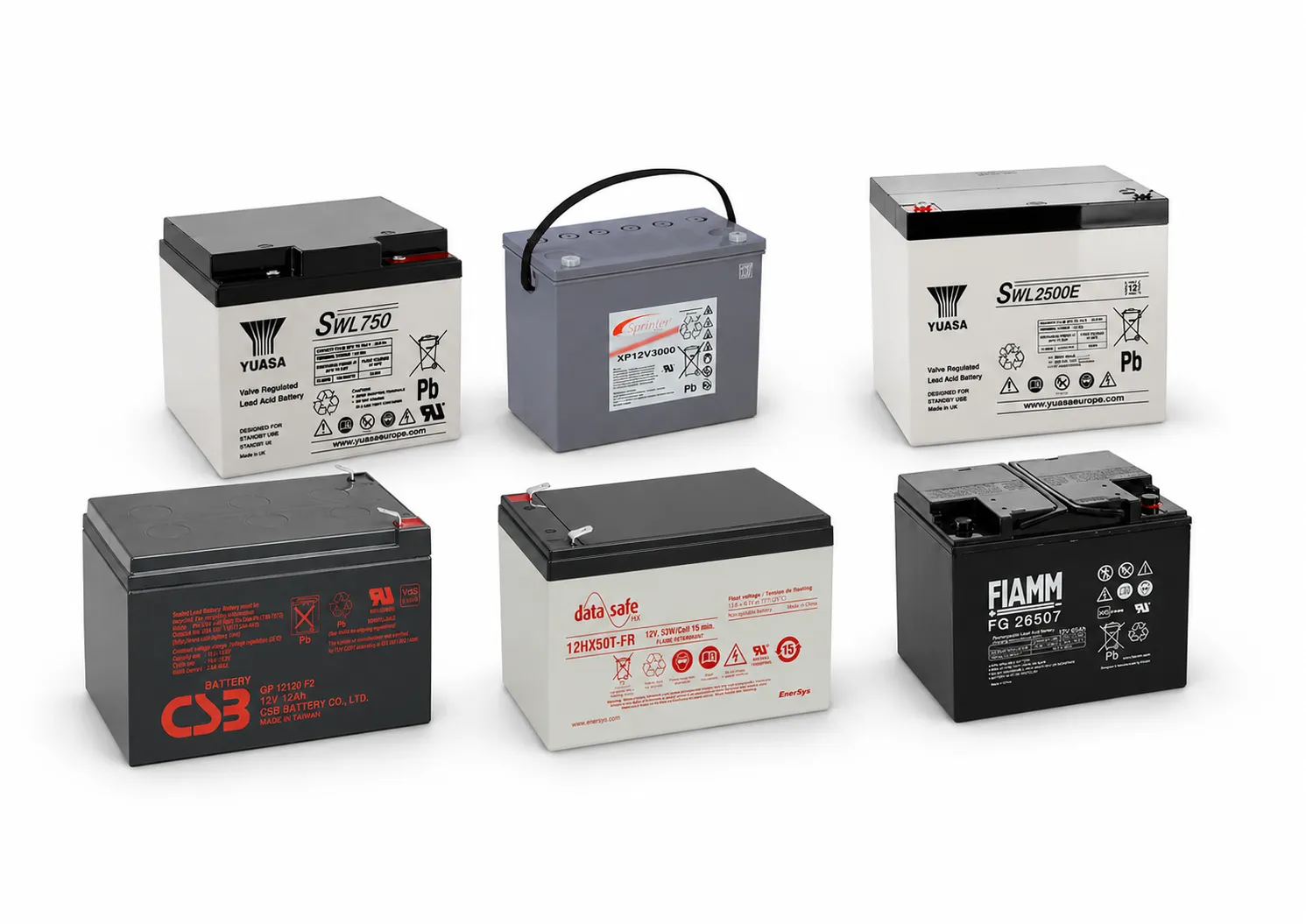
When choosing a battery for your UPS, the priority is the voltage and battery type recommended by the unit's manufacturer. Within these limits, choosing a quality battery suitable for UPS use directly affects both backup time and battery life. At ELSIPOWER we supply ELSIPOWER VRLA / AGM batteries in various capacities as well as batteries from brands widely used in UPS systems such as Yuasa and CSB. You can browse all options on our battery range page.
How to Read a Battery Label
The first step in choosing the right battery is to read your current battery's label correctly. A UPS battery label usually shows the following information:
- Voltage (V): Small UPS batteries are mostly marked 12V. Your new battery must have the same value.
- Capacity (Ah): For example “7Ah” or “9Ah”. It is usually given based on a 20-hour discharge.
- Battery type: “VRLA”, “AGM” or “Sealed Lead Acid” indicate a maintenance-free sealed battery.
- Charging voltage: The “Standby use” and “Cycle use” values state the voltage at which the battery should be charged.
- Terminal type: Shown on the label or in the datasheet with codes such as F1 or F2.
Photographing this information and sending it to us allows the right battery to be identified quickly and accurately.
Tips to Extend Battery Life
Whatever its capacity, how long a battery stays healthy depends largely on its operating conditions:
- Use the UPS in a cool, well-ventilated place; high temperature significantly shortens battery life.
- Avoid fully discharging the battery frequently; during long outages, shut down connected equipment in a controlled way.
- After an outage, give the UPS time to fully recharge the batteries.
- If you will not use a UPS for a long time, connect it to the mains at intervals to charge the batteries.
- Have periodic battery tests done to detect weakening batteries before an outage occurs.
Frequently Asked Questions
Will my UPS break if I fit a 9 Ah battery instead of a 7 Ah one?
No, as long as the voltage and battery type are the same and the dimensions fit. The UPS will charge the battery; only the time to full charge increases.
Can a larger battery, such as 12 Ah instead of 7 Ah, be fitted?
It may be electrically possible, but larger batteries usually do not fit in the UPS battery compartment and charging time increases significantly. For longer backup, a model with external battery support is the better solution.
Can I use one 9 Ah and one 7 Ah battery together?
No. All batteries in the same string must have the same capacity and the same age. Mixing them shortens the life of the whole string.
How do I find out which Ah value is suitable for my UPS?
The battery voltage and type are written on the unit's label or in the user manual. You can send us the brand and model to find out suitable battery options.
Let's choose the right battery for your UPS together
Send us your UPS brand and model and the details on your current battery label; we will let you know the suitable battery options and stock availability right away. You can call us on 0212 210 75 51 or send an email to elsi@elsi.com.tr.