Servo ve statik voltaj regülatörlerinin farkları, kullanım alanları, Regülatör doğru kVA seçimi ve 2026 fiyatları hakkında kapsamlı rehber.
Voltaj Regülatörü Nedir? Servo–Statik Regülatör Farkı ve 2026 Fiyatları
12 Nisan
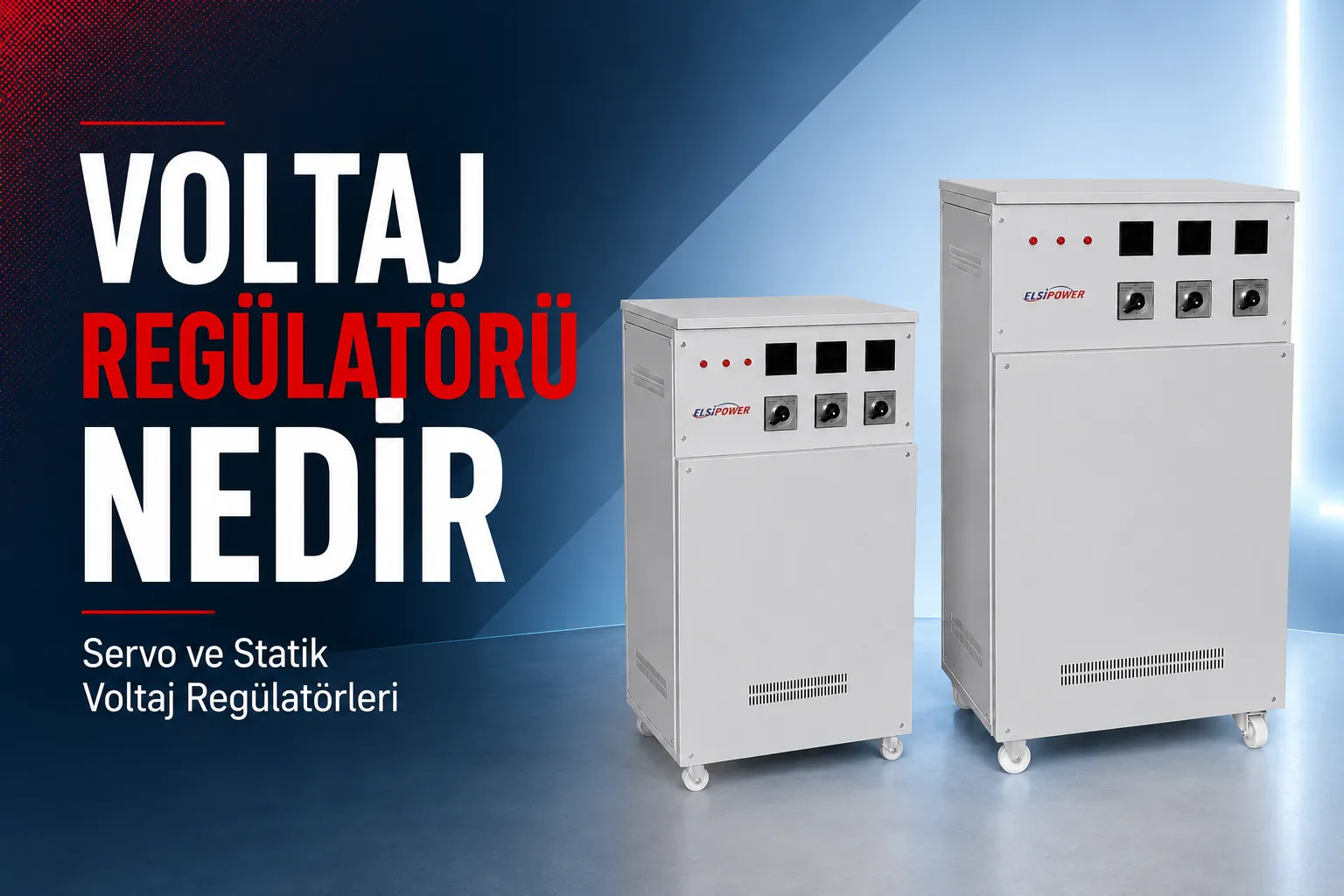
What Is a Voltage Regulator? Servo vs. Static Regulators and 2026 Prices
Low or high voltage in the electrical grid can cause many electrical and electronic devices—from industrial machinery and computers to medical equipment and automation systems—to operate unpredictably or fail prematurely. A voltage regulator is a power-electronics device designed to regulate fluctuating mains voltage and supply connected equipment with a more stable output voltage.
In this guide, we explain what a voltage regulator does, where it is used, the differences between a servo voltage regulator and a static voltage regulator, how the correct capacity is determined, and which factors affect voltage regulator prices in 2026.
To determine the right regulator capacity for your company or facility, you can obtain information about Elsipower Regulators by contacting the Elsipower technical team at +90 212 210 75 51.
What Is a Voltage Regulator?
A voltage regulator is a device that regulates voltage drops, voltage rises and voltage fluctuations within specified operating limits to maintain a stable output voltage. These devices may also be referred to as automatic voltage regulators, voltage stabilizers or AVRs.
In Türkiye, the nominal low-voltage mains supply is approximately 230 V for single-phase systems and approximately 400 V between phases for three-phase systems. However, voltage levels may change due to the structure of the grid, distance from the transformer, cable cross-section, regional demand and high-power machinery switching on and off.
A regulator continuously monitors the input voltage. When the voltage falls below the required level, it increases it; when the voltage rises above that level, it reduces it. This provides a more stable power output, provided that the voltage remains within the regulator’s specified operating range and capacity.
What Does a Voltage Regulator Do?
The primary function of a voltage regulator is to reduce the exposure of electrical equipment to unsuitable voltage conditions. In areas where mains voltage frequently rises and falls throughout the day, a properly selected regulator can provide the following benefits:
- It regulates low and high voltage within its specified operating limits.
- It helps sensitive electronic boards receive a more stable voltage supply.
- It reduces the risk of machinery stopping or entering protection mode due to low voltage.
- It supports stable operation in electric motors and automation systems.
- It can help reduce voltage-related production interruptions and unplanned service requirements.
- It may help protect the service life of connected equipment.
However, a voltage regulator is not an uninterruptible power supply. A standard regulator does not supply power from batteries when the mains supply is completely interrupted. A UPS should be considered if equipment must continue operating during a power outage, while a regulator should be considered when voltage regulation is required. In some projects, a UPS and regulator may be used together, but the final decision should be based on a load and mains analysis.
Where Are Voltage Regulators Used?
Voltage regulators are used in a wide range of applications, from residential equipment to large industrial facilities. The need for a regulator should not be assessed solely according to total power. The sensitivity of the connected loads and the behaviour of the electrical grid must also be considered.
Factories and manufacturing facilities
CNC machines, laser-cutting machines, injection-moulding machines, textile machinery, packaging lines, automation panels and motor drives can all be affected by voltage fluctuations. When selecting a voltage regulator for a factory, starting currents, simultaneously operating loads and the facility’s three-phase electrical structure must be taken into account.
CNC and precision manufacturing machinery
Rapid voltage fluctuations in CNC control boards and precision manufacturing systems can result in error codes, unplanned downtime or electronic-board failures. In applications where voltage changes occur rapidly, a static regulator may be preferred due to its faster response time.
Hospitals and healthcare facilities
Power quality is important for sensitive equipment used in hospitals, laboratories, imaging centres, dental clinics and similar facilities. Before selecting a regulator for medical equipment, the manufacturer’s requirements, electrical infrastructure and need for uninterrupted operation should be assessed together.
Data centres and server rooms
Servers, networking equipment and communication systems may require both voltage regulation and backup power against outages. Regulators, UPS systems, generators and power-distribution infrastructure should therefore be designed as an integrated solution for data-centre applications.
Workplaces, shops and offices
Single-phase or three-phase regulators may be used in workplaces containing computers, printers, security systems, lift electronics, lighting equipment and air-conditioning systems. The correct system should be selected according to the electrical panel and the loads that need to be protected.
Homes, villas and rural areas
A residential voltage regulator may be preferred in areas where mains voltage drops, particularly during peak evening hours. The total power consumption of refrigerators, televisions, air conditioners, boilers and other appliances should be calculated before a regulator is selected.
Other areas of use
- Hotels and tourism facilities
- Shopping centres and large retail stores
- Agricultural and irrigation systems
- Cold-storage facilities
- Printing and publishing facilities
- Workshops and industrial estates
- Telecommunication centres
- Schools and public institutions
- Restaurants, cafés and supermarkets
- Warehouses and logistics centres
What Is a Servo Voltage Regulator?
A servo voltage regulator is a regulator that measures the input voltage and adjusts the output through a servo motor, variac and transformer system. The servo motor moves mechanically in response to voltage changes and enables the required voltage correction.
Servo regulators have been used for many years in industrial facilities, workshops, workplaces, residential buildings and various commercial applications. They can offer a suitable solution for projects where voltage fluctuations are not extremely rapid and an economical, reliable system is required.
Advantages of servo voltage regulators
- They are available in a wide range of single-phase and three-phase capacities.
- They can provide an economical solution at high power ratings.
- They can regulate stable and relatively slow mains-voltage fluctuations effectively.
- They are widely used in industrial and general-purpose applications.
- Maintenance and technical-service support are generally widely available.
Points to consider with servo regulators
- They contain moving components such as a motor and carbon brush.
- Their response time is slower than that of static systems.
- Periodic maintenance may be required depending on operating conditions.
- Applications involving rapid and continuous fluctuations require detailed analysis.
What Is a Static Voltage Regulator?
A static voltage regulator regulates voltage through power electronics and semiconductor switching technology rather than moving mechanical components. Because no mechanical movement is required, it can respond to mains voltage changes more quickly than a servo regulator.
Static regulators can be considered for CNC machines, sensitive automation systems, medical equipment, laboratory equipment and facilities experiencing rapid voltage fluctuations. However, not every static regulator has the same specifications. Input voltage range, response time, output accuracy, protection features and overload capacity should always be examined.
Advantages of static voltage regulators
- They can respond quickly to voltage fluctuations.
- They are designed without moving mechanical components.
- They may require less mechanical maintenance.
- They can be preferred in environments where quiet operation is important.
- They offer suitable options for sensitive electronic and industrial loads.
Points to consider with static regulators
- The initial purchase cost may be higher than that of servo models.
- Servicing electronic power circuits requires specialist expertise.
- Incorrect input range or capacity selection can prevent the expected performance.
- Technical specifications must be selected according to the project’s load characteristics.
Differences Between Static and Servo Voltage Regulators
| Comparison | Servo Voltage Regulator | Static Voltage Regulator |
|---|---|---|
| Operating technology | Servo motor and mechanical regulation system | Power electronics and semiconductor switching |
| Response time | Slower due to mechanical movement | Generally faster |
| Moving components | Present | Generally not present |
| Maintenance requirements | Periodic maintenance may be required depending on use | Lower mechanical-maintenance requirement |
| Noise level | Motor movement may generate noise | Can provide quieter operation |
| Initial investment cost | Generally more economical | Generally higher |
| Suitable applications | General industry, workshops, buildings and commercial facilities | CNC systems, medical equipment and sensitive electronic loads |
| Suitability for rapid fluctuations | Requires mains analysis | More advantageous where a rapid response is required |
Should You Choose a Static or Servo Voltage Regulator?
There is no single regulator technology that is right for every project. The selection should be based on mains conditions, load sensitivity, budget, the speed of voltage fluctuations and maintenance expectations.
If the mains voltage rises and falls relatively slowly throughout the day, the connected loads are not extremely sensitive and the purchase budget is a priority, a servo voltage regulator may be suitable. If the facility contains CNC equipment, medical devices, laboratory systems or sensitive automation loads, and voltage fluctuations occur rapidly, a static voltage regulator should be considered.
The decision should not be based solely on whether the regulator is static or servo-controlled. Its input voltage range, output accuracy, correction speed, protection features, kVA capacity, overload behaviour and after-sales technical service should also be compared.
What Is the Difference Between Single-Phase and Three-Phase Regulators?
A single-phase voltage regulator is used for single-phase electrical installations or loads. Homes, small offices, retail shops and individual devices operating on a single-phase supply are examples of single-phase applications.
A three-phase voltage regulator is designed for machinery and electrical installations operating on a three-phase supply. Three-phase regulators may be required for factories, production lines, CNC machinery, large motors, pumps, compressors and high-power commercial facilities.
A three-phase electrical installation does not necessarily mean that every load within the facility is three-phase. The connection type, phase distribution and total power of the equipment requiring protection should be examined. An on-site survey and electrical measurements are particularly important in systems with unbalanced phase loads.
What kVA Voltage Regulator Is Required?
Regulator capacity is generally expressed in kVA. To determine the correct capacity, the total power of the equipment requiring protection must be calculated. Power factor, simultaneous usage, starting currents and loads that may be added in the future should also be considered.
Motors, pumps, compressors, air conditioners and some production machines can draw significantly more current during start-up than during normal operation. Therefore, simply adding together the watt ratings shown on equipment labels does not always produce the correct result.
Information required for regulator capacity calculation
- Total active and apparent power of the connected equipment
- Single-phase or three-phase connection structure
- Starting currents of motors and compressors
- Simultaneous operating ratio of the loads
- Lowest and highest mains voltages measured at the facility
- Sensitivity level of the connected equipment
- Planned future capacity increases
- Ambient temperature, ventilation and installation conditions
Regulator capacities such as 5 kVA, 10 kVA, 15 kVA, 20 kVA, 30 kVA, 45 kVA, 60 kVA, 75 kVA, 100 kVA, 150 kVA, 200 kVA, 250 kVA, 300 kVA, 500 kVA and higher may be used in different applications. However, selecting a system solely according to its nominal capacity is not recommended.
To determine the correct capacity for your single-phase or three-phase system, send your equipment list and mains-voltage measurements to elsi@elsi.com.tr. The Elsipower technical team can help identify a suitable voltage regulator for your application.
What Should You Consider When Choosing a Voltage Regulator?
- Input voltage range: The regulator must be able to accommodate the lowest and highest mains voltages measured at the facility.
- Output voltage and accuracy: These must be compatible with the voltage tolerances of the connected equipment.
- Power capacity: Total load, starting currents and an appropriate safety margin should be included in the calculation.
- Single-phase or three-phase design: The regulator must be compatible with the mains supply and load connection.
- Correction and response time: The speed at which the regulator responds to voltage changes is important for sensitive loads.
- Protection features: Protection against overvoltage, undervoltage, overcurrent, excessive temperature and phase faults should be examined.
- Bypass option: How the load will be supplied during maintenance or a regulator fault should be considered during project planning.
- Efficiency and energy losses: These affect the overall operating cost, particularly in continuously operating high-power systems.
- Installation environment: Temperature, humidity, dust, ventilation and the required maintenance space around the unit must be considered.
- Technical-service support: Access to maintenance, spare parts and technical support after the sale is important.
Voltage Regulator Prices in 2026
Voltage regulator prices in 2026 cannot be represented by a single standard figure. Prices vary according to the regulator technology, capacity, number of phases, input voltage range and additional project-specific features. Two regulators with the same kVA rating may therefore have significantly different technical specifications.
Main factors affecting regulator prices in 2026
- Servo or static regulator technology
- Single-phase or three-phase design
- Regulator kVA capacity
- Standard or extended input voltage range
- Output voltage accuracy
- Correction and response time
- Specifications of copper and power-electronics components
- Manual or automatic bypass options
- Custom enclosure, IP protection rating and environmental conditions
- Installation, commissioning, transportation and technical-service scope
In general, servo voltage regulator prices may be more affordable in terms of the initial investment. Static voltage regulator prices may be higher due to their faster response, lack of moving mechanical components and lower mechanical maintenance requirements. The purchase decision should not be based only on the initial price. Maintenance costs, production losses, energy efficiency and equipment protection should be included in the total cost of ownership.
The facility’s phase structure, total load, measured mains-voltage range and intended application must be known before an accurate quotation can be prepared. A price supplied without this information may not represent the correct regulator for the application.
Voltage Regulator Sales and Technical Support in Istanbul
Elsipower provides voltage regulator solutions for businesses in Beylikdüzü, Esenyurt, Avcılar, Büyükçekmece, Küçükçekmece, Başakşehir, Arnavutköy, Silivri, Çatalca, Bakırköy, Bahçelievler, Bağcılar, Bayrampaşa, Eyüpsultan, Kağıthane, Şişli, Sarıyer, Beşiktaş, Fatih, Zeytinburnu, Güngören, Ümraniye, Kadıköy, Ataşehir, Pendik, Kartal, Tuzla and other districts of Istanbul.
Requirements such as a three-phase regulator for a factory, a servo regulator for a commercial building, a static regulator for a CNC machine or a central voltage regulator for an entire building should be assessed according to the required capacity and local mains conditions.
Voltage Regulator Solutions Across Türkiye
Elsipower Regulators can be considered for industrial and commercial businesses in Istanbul, Ankara, Izmir, Bursa, Kocaeli, Tekirdağ, Sakarya, Balıkesir, Çanakkale, Manisa, Denizli, Konya, Kayseri, Eskişehir, Antalya, Mersin, Adana, Gaziantep, Kahramanmaraş, Hatay, Samsun, Trabzon, Diyarbakır and throughout Türkiye.
Voltage regulator selection for organised industrial zones, manufacturing facilities, hotels, hospitals, workshops and commercial buildings should not be based solely on the city or region. Measurements taken at the facility and the technical specifications of the connected loads should form the basis of the selection.
10 Frequently Searched Topics About Voltage Regulators
Users researching voltage regulators frequently search for answers to the following questions:
- What is a voltage regulator?
- What does a voltage regulator do?
- How much does a voltage regulator cost?
- What is a servo voltage regulator?
- What is a static voltage regulator?
- Which is better: a static or servo voltage regulator?
- What kVA voltage regulator is required for a house?
- What is the difference between single-phase and three-phase regulators?
- Does a voltage regulator work during a power outage?
- What is the difference between a UPS and a voltage regulator?
Frequently Asked Questions About Voltage Regulators
1. What is a voltage regulator?
A voltage regulator is an electrical device that regulates low or high mains voltage within specified operating limits and supplies connected equipment with a more stable voltage.
2. Does a voltage regulator reduce electricity bills?
The primary purpose of a regulator is to regulate voltage, not to reduce energy consumption. Electricity consumption varies according to the load, and the regulator itself also has efficiency losses. It should therefore not be considered an electricity-saving device.
3. Does a regulator work during a power outage?
A standard voltage regulator does not contain energy-storage batteries and cannot supply power when the mains supply is completely interrupted. A correctly sized UPS is required for backup power during an outage.
4. What is the difference between a UPS and a voltage regulator?
A regulator controls mains voltage. Depending on its technology, a UPS can regulate power and also supply energy from batteries for a limited period when the mains supply fails. The correct system should be selected according to the facility’s actual power problem.
5. Which is better: a servo or static regulator?
There is no single correct answer for every application. A servo regulator may suit economical, general-purpose applications. A static regulator may be preferable for sensitive systems requiring rapid response, quiet operation and lower mechanical maintenance.
6. What kVA regulator is required for a house?
The exact capacity cannot be determined without knowing the home’s total power consumption, number of air conditioners and motor-driven appliances, simultaneous usage and lowest measured mains voltage. Capacity should be calculated from an equipment list and measurements taken at the electrical panel.
7. Can a voltage regulator be connected to an entire building?
If the project conditions are suitable, a central regulator with the correct power and phase structure can be connected to the main distribution line. Selection and installation must be carried out by qualified technical personnel.
8. Does a regulator completely solve low-voltage problems?
The output voltage can be regulated when the input voltage remains within the regulator’s specified operating range. If the input voltage falls outside this range, the regulator may enter protection mode or may be unable to provide the required correction.
9. Does a regulator protect against lightning and voltage surges?
A voltage regulator alone cannot guarantee protection against every lightning event or transient surge. Surge-protection devices, correct earthing, circuit breakers and other protection equipment should be coordinated within the electrical system.
10. When should a voltage regulator be serviced?
The service interval depends on the regulator technology, operating environment, load ratio and manufacturer’s recommendations. Moving components in servo regulators should be inspected, while fans, electrical connections, filters and operating values should be checked periodically in both technologies.
11. Why do voltage regulator prices vary?
Voltage regulator prices vary according to kVA capacity, servo or static technology, single-phase or three-phase design, input voltage range, protection features and project-specific equipment.
12. What happens if the regulator capacity is too small?
Insufficient capacity may cause overloading, overheating, protection shutdowns, interrupted output or reduced equipment life. Starting current is particularly important when the system supplies motors, pumps or compressors.
Conclusion: How Do You Choose the Right Voltage Regulator?
The correct voltage regulator is not necessarily the cheapest unit or the model with the highest capacity. It is the regulator that matches the facility’s actual mains conditions and the characteristics of the connected equipment. When choosing between servo and static regulators, the speed of voltage fluctuations, load sensitivity, maintenance expectations and total investment cost should be considered together.
Elsipower Regulators provide project-specific options for single-phase and three-phase applications, industrial facilities, commercial businesses and sensitive equipment. For information about voltage regulator prices in 2026, capacity calculations and technical specifications, call +90 212 210 75 51 or email elsi@elsi.com.tr.
Share