UPS sistemlerinin çalışma prensibi, UPS odası gereksinimleri, en sık karşılaşılan UPS arızaları, bakım süreçleri ve profesyonel teknik servis çözümleri hakkında kapsamlı rehber.
UPS Nedir? UPS Açılımı, UPS Odası, Arızaları ve Bakım Rehberi
11 Mayıs
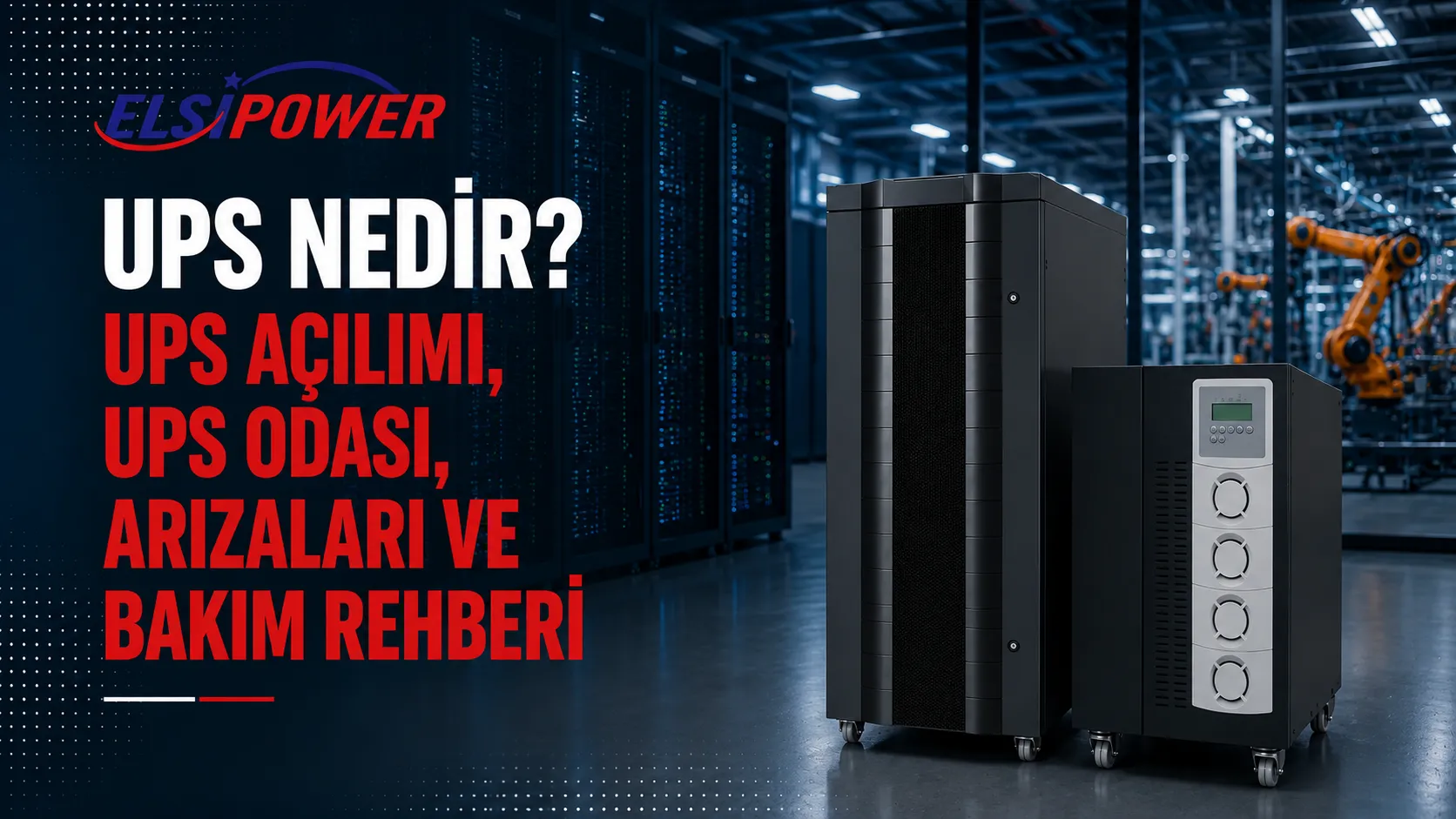
What Is a UPS? UPS Definition, UPS Room, Common Failures and Maintenance Guide
UPS is the abbreviation of Uninterruptible Power Supply. It is commonly referred to as an uninterruptible power supply or backup power system. UPS systems are professional power protection solutions designed to keep connected equipment operating safely during power outages, voltage fluctuations, sudden voltage drops, and utility power problems.
Today, UPS systems are essential for server rooms, data centers, factories, hospitals, security systems, offices, manufacturing facilities, and critical infrastructures. A power interruption can cause much more than equipment shutdown. It may lead to data loss, production downtime, system failures, operational disruption, and serious financial losses.
In this guide, you will find detailed information about what a UPS is, what a UPS does, what a UPS room is, the most common UPS failures, why UPS maintenance is important, and why professional UPS technical service support is necessary for reliable operation.
What Does UPS Mean?
A UPS is a power protection system used to provide uninterrupted electrical energy. Under normal utility conditions, it supplies power to connected devices and charges its internal or external batteries at the same time. When the mains power fails, the batteries automatically take over and continue supplying energy to the connected equipment.
This system is especially important for computers, servers, network devices, security cameras, automation systems, medical devices, and production lines where uninterrupted operation is critical.
What Does UPS Stand For?
UPS stands for Uninterruptible Power Supply. In simple terms, it is a system that prevents devices from shutting down suddenly during power cuts and provides safe backup time for users and businesses.
A UPS does not only protect against power outages. It also helps protect sensitive devices against voltage irregularities and power quality problems. For this reason, UPS systems are preferred in all businesses where reliable energy is important.
What Is the Purpose of a UPS?
The main purpose of an uninterruptible power supply is to continue providing power to connected devices when a power outage or utility failure occurs. However, UPS systems are not limited to short-term backup power only.
- Prevents devices from shutting down during power outages.
- Protects equipment against voltage fluctuations.
- Helps prevent data loss in server and network systems.
- Reduces the risk of unexpected downtime in production facilities.
- Supports the safe operation of sensitive electronic devices.
- Provides critical systems with additional operating time through battery backup.
- Protects against sudden power disturbances coming from the grid.
For businesses, using a UPS provides a major advantage in terms of operational continuity. Even a power interruption lasting only a few seconds can cause serious problems in servers, computers, security systems, or automation infrastructure.
How Does a UPS Work?
During normal operation, a UPS receives energy from the utility grid and transfers it to connected loads. At the same time, it charges the batteries located inside the UPS or in external battery cabinets. When the power goes out, the mains voltage drops, or the incoming voltage goes outside acceptable limits, the UPS automatically switches to battery mode.
This transfer happens very quickly, so connected devices do not shut down. In online UPS systems, the transfer is more stable and continuous. For this reason, online UPS solutions are commonly preferred in server rooms, data centers, and other critical systems.
Which UPS Capacity Should Be Used?
When selecting a UPS, businesses should consider not only the brand of the device but also the total power requirement of the connected loads. Choosing a UPS with the wrong capacity may cause overload errors, insufficient protection, and unexpected system interruptions.
For small offices, security systems, network equipment, and individual applications, 6 kVA UPS and 10 kVA UPS solutions are commonly preferred. This power range can be suitable for modems, computers, camera systems, small servers, and office equipment.
For medium-sized businesses, 20 kVA UPS, 30 kVA UPS, and 40 kVA UPS systems are widely used. These systems can support higher loads and meet the critical power requirements of many commercial environments.
For factories, production facilities, hospitals, data centers, and large-scale businesses, high-capacity UPS systems such as 60 kVA UPS, 120 kVA UPS, and 200 kVA UPS are preferred. These systems help keep servers, network infrastructure, automation panels, and critical production equipment operating without interruption.
If you are not sure which UPS capacity is suitable for your business, a professional load analysis should be carried out. ELSIPOWER specialists can analyze your existing loads and help determine the most suitable UPS solution for your needs. For technical inspection and product selection, you can contact us at 0212 210 75 51.
What Is a UPS Room?
A UPS room is a dedicated technical area where uninterruptible power supplies, battery cabinets, power distribution equipment, and related electrical infrastructure are installed. In large businesses, data centers, hospitals, and production facilities, UPS systems are usually positioned in a separate technical room.
The operating conditions of a UPS room are very important for device performance. High temperature, humidity, dust accumulation, and insufficient ventilation may cause battery, fan, and electronic board failures in UPS systems.
What Should Be Considered in a Healthy UPS Room?
- Room temperature should be kept under control.
- Adequate ventilation should be provided.
- Humidity levels should be kept within suitable limits.
- Dust and dirt accumulation should be prevented.
- Battery cabinets should be positioned safely.
- Electrical connections should be checked regularly.
- Periodic UPS maintenance should not be neglected.
Neglecting the UPS room shortens the service life of the equipment and increases the risk of failure. For this reason, UPS rooms should be inspected regularly, and maintenance and cleaning processes should be carried out by qualified technical teams.
Why Do UPS Failures Occur?
UPS devices are professional power systems that operate continuously. Therefore, some components may wear out over time. Battery problems, fan failures, electronic board faults, fuse issues, and connection problems are especially common in UPS systems that do not receive regular maintenance.
Many UPS failures can be prevented with timely maintenance and routine inspections. Instead of waiting for a failure to occur, detecting potential problems in advance through periodic maintenance is safer and more cost-effective for businesses.
- End of battery service life
- Fan failures
- Excessive temperature
- Dust and dirt accumulation
- Voltage problems caused by the utility grid
- Connecting loads above the UPS capacity
- Electronic board failures
- Lack of regular maintenance
- Incorrect installation or insufficient ventilation
Most Common UPS Failures and Troubleshooting Methods
1. UPS Battery Failure
One of the most common failures in UPS systems is battery-related problems. Batteries lose capacity over time and may no longer provide sufficient backup time during a power outage.
Symptoms:
- Connected devices shut down when the power fails.
- Battery warning light appears on the UPS.
- Backup time decreases noticeably.
- Battery fault codes appear on the display.
- Batteries become swollen or physically deformed.
In case of a UPS battery failure, the batteries should be tested with professional battery testing equipment. Batteries that have reached the end of their service life should be replaced. Correct battery capacity and proper connection layout are important during replacement. For UPS battery failure support, you can call ELSIPOWER Technical Service: 0212 210 75 51.
2. UPS Keeps Beeping Continuously
A continuous alarm or beeping sound from a UPS indicates that the device is warning the user about a problem. This sound may be caused by battery issues, overload conditions, or internal system errors.
Possible causes:
- Low battery level
- Overload
- Utility voltage problem
- Fan failure
- Internal system errors
- Bypass warning
The cause of the alarm should be evaluated through the fault codes shown on the UPS display. Unauthorized intervention may cause more serious damage to the device. For UPS alarm and fault code support, you can contact the ELSIPOWER Technical Service Line at 0212 210 75 51.
3. UPS Fan Failure
UPS fans keep the internal temperature of the device under control. If the fans stop working or fail to provide sufficient cooling, electronic boards and power components may be damaged.
Symptoms:
- Overtemperature warning
- Loud or abnormal fan noise
- Temperature alarm
- Decrease in device performance
- UPS entering protection mode
Continuing to operate the device with a fan failure may lead to more serious faults. Fan inspection, cleaning, and replacement should be carried out by experienced technical teams. For fan failure support, you can contact us through the ELSIPOWER Technical Service Line: 0212 210 75 51.
4. UPS Overload Error
When a load above the UPS capacity is connected, the device may give an overload error. This may cause the UPS to switch to bypass mode or shut down for protection.
Symptoms:
- Continuous alarm sound
- Switching to bypass mode
- UPS unable to support the connected load
- Protective shutdown
- Load level warning
In this situation, a system load analysis should be performed and the current UPS capacity should be checked. If necessary, a higher-capacity UPS system should be selected. For load analysis and capacity control, you can call the ELSIPOWER Technical Service Line: 0212 210 75 51.
5. UPS Does Not Turn On
If the UPS does not turn on at all, this may indicate a more serious failure. The cause may be related to the battery group, fuse, power board, rectifier, or inverter.
Possible causes:
- Battery group completely discharged
- Fuse failure
- Power board failure
- Rectifier failure
- Inverter failure
- Internal connection problems
In such cases, the device should not be opened by unauthorized persons. Incorrect intervention may create risks for both device safety and user safety. For fault diagnosis and on-site service, you can contact the ELSIPOWER Technical Service Line: 0212 210 75 51.
6. UPS Backup Time Has Decreased
If a UPS operates for a shorter time than before, this usually indicates reduced battery performance. However, in some cases, an increase in connected load may also reduce backup time.
For this reason, instead of replacing batteries immediately, load analysis and battery testing should be performed first. The ELSIPOWER technical team can check the backup time of your UPS system and determine the correct solution.
Can a UPS and Automatic Voltage Regulator Be Used Together?
Voltage fluctuations can be as risky for electronic devices as power outages. Especially in industrial facilities, factories, and regions with poor power quality, using UPS systems together with an automatic voltage regulator is often recommended.
An automatic voltage regulator stabilizes low or high voltage coming from the utility grid. The UPS system provides protection against power outages. When these two systems are used together, the power infrastructure becomes more stable and reliable.
Thanks to an automatic voltage regulator, the UPS batteries may not need to switch to battery mode unnecessarily as often. This can help support battery life, improve device performance, and keep critical systems operating more safely.
ELSIPOWER provides uninterruptible power supply systems, UPS maintenance services, UPS fault solutions, UPS battery replacement, and automatic voltage regulator solutions. If you are experiencing voltage-related problems or would like your existing UPS infrastructure to be inspected, you can receive 24/7 support through the WhatsApp line on our website or call our technical service line at 0212 210 75 51.
Why Is UPS Maintenance Important?
UPS systems operate reliably not only when they are repaired after a failure, but also when they are maintained regularly. Periodic UPS maintenance helps preserve device performance and prevent unexpected failures.
In UPS systems that are not maintained, battery performance may decrease, fans may fail to operate properly, electronic boards may experience overheating problems, and the device may become unavailable at a critical moment.
- Battery performance is measured.
- Fans and filters are checked.
- Electronic boards are inspected.
- Connection points are checked.
- Thermal inspections are performed.
- Backup time is tested.
- Potential failures are prevented before they become serious.
- UPS room conditions are evaluated.
Neglecting UPS maintenance in data centers, server rooms, factories, and hospitals can create serious operational risks. For this reason, UPS maintenance should be performed regularly by professional technical teams.
How Often Should UPS Maintenance Be Performed?
For UPS systems, periodic maintenance at least twice a year is recommended. However, in heavily used systems, high-capacity UPS devices, and critical infrastructures, maintenance intervals should be shorter.
For critical facilities, quarterly inspections, semi-annual detailed maintenance, and annual comprehensive performance tests may provide a safer maintenance approach.
If your UPS maintenance period has arrived or you are not sure about the performance of your device, you can contact the ELSIPOWER Technical Service Line: 0212 210 75 51.
UPS Technical Service and Fault Support in Istanbul
ELSIPOWER provides UPS technical service, UPS maintenance, UPS battery replacement, UPS fault diagnosis, and on-site service throughout Istanbul. We offer fast, reliable, and professional solutions for businesses experiencing UPS failures in Istanbul.
We provide on-site technical service in all districts of Istanbul, especially Beylikdüzü, Esenyurt, Avcılar, Büyükçekmece, Küçükçekmece, Başakşehir, Bakırköy, Bahçelievler, Zeytinburnu, Bayrampaşa, Gaziosmanpaşa, Kağıthane, Şişli, Beşiktaş, Sarıyer, Ümraniye, Ataşehir, Kadıköy, Maltepe, Kartal, Pendik, and Tuzla.
If your UPS is giving an alarm, the battery backup time has decreased, the device shows an overload error, the UPS does not turn on, or maintenance is due, you can contact the ELSIPOWER technical service team.
ELSIPOWER UPS Technical Service Solutions
- UPS fault diagnosis
- UPS battery replacement
- Periodic UPS maintenance
- UPS fan replacement
- UPS electronic board inspection
- UPS load analysis
- UPS room inspection
- On-site technical service
- 24/7 WhatsApp support
- Automatic voltage regulator solution support
To create a fault record, submit a maintenance request, or receive technical support, you can contact us 24/7 through the WhatsApp line available on our website.
Technical Service Line: 0212 210 75 51
E-Mail: elsi@elsi.com.tr
Website: www.elsi.com.tr
Conclusion
UPS systems are critical devices that protect businesses against power interruptions. A properly selected, correctly installed, and regularly maintained uninterruptible power supply helps prevent data loss, production downtime, and equipment failures.
6 kVA UPS, 10 kVA UPS, 20 kVA UPS, 30 kVA UPS, 40 kVA UPS, 60 kVA UPS, 120 kVA UPS, and 200 kVA UPS systems can be selected according to different business needs. Professional site inspection and load analysis are important for choosing the right UPS system.
If your UPS device has an alarm, battery problem, fan failure, overload error, or performance loss, do not wait for the problem to grow. You can contact the ELSIPOWER expert technical service team and receive professional support.
Uninterrupted energy, uninterrupted trust.
Share