Hastaneler, matbaa firmaları, fabrikalar ve kritik tesisler için modüler UPS seçimi, çalışma prensibi, bakım ve teknik servis rehberi.
Modüler UPS Nedir? Avantajları, Bakımı ve Teknik Servisi
3 Mayıs
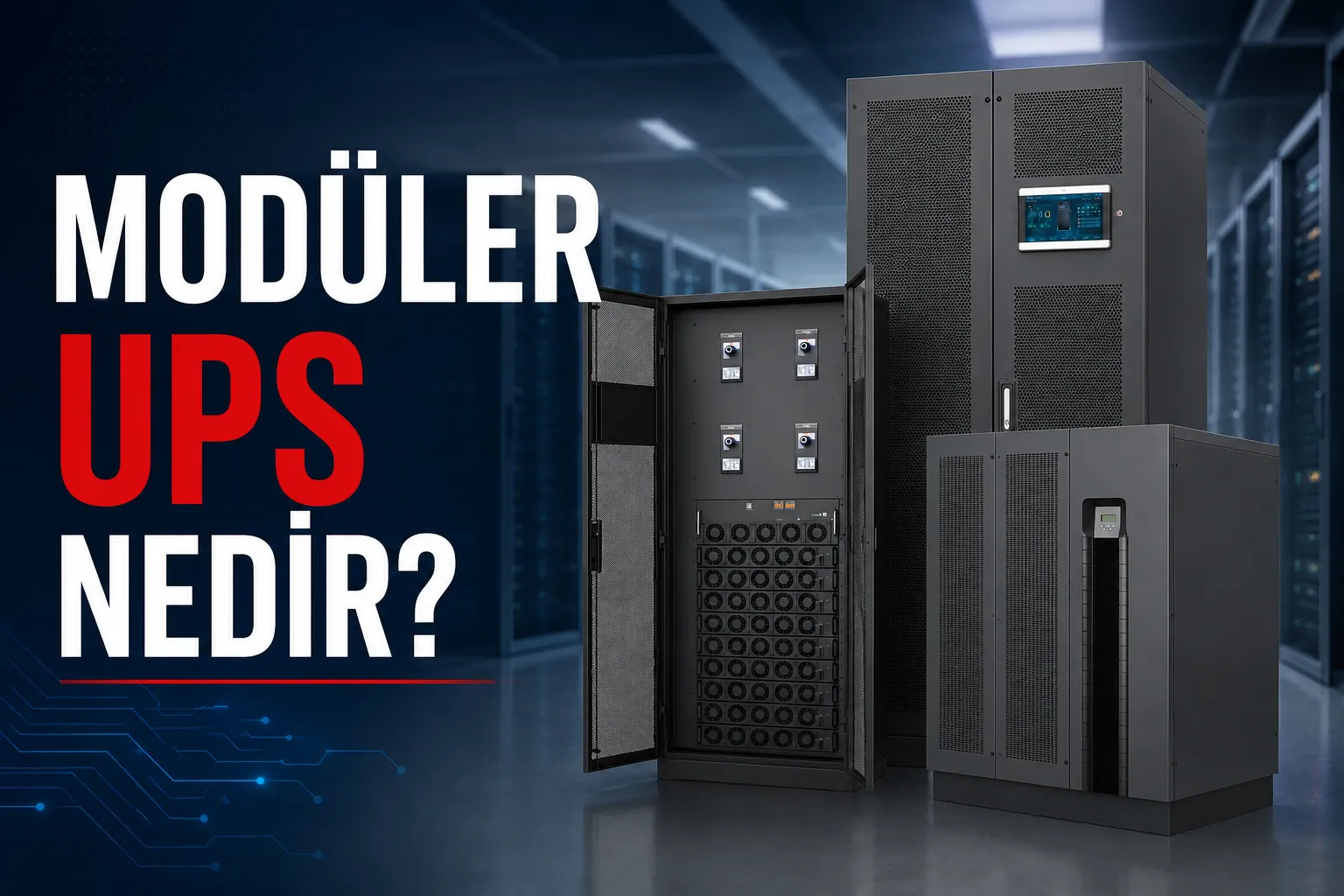
What Is a Modular UPS? Modular Uninterruptible Power Supply Selection, Maintenance and Technical Service
Power outages, voltage fluctuations and power quality problems can cause serious financial losses in many businesses, ranging from hospitals and printing companies to data centers and manufacturing facilities. Modular UPS systems are scalable uninterruptible power supply solutions designed to ensure the continuous operation of critical equipment and production processes.
Unlike conventional UPS systems, a modular UPS generates its total power through independent power modules operating in parallel within the same cabinet. When a company’s power requirements increase, additional modules can be installed if the system infrastructure supports expansion. This structure offers flexibility for growing businesses, redundancy for critical facilities and significant advantages during maintenance.
With experience in power electronics dating back to 1978, ELSIPOWER provides modular UPS selection, sales, project planning, commissioning, periodic maintenance and technical service solutions. To determine the appropriate system for your facility and request a quotation, call +90 212 210 75 51 or contact us at elsi@elsi.com.tr.
What Is a Modular UPS?
A modular UPS is an uninterruptible power supply system in which the total output power is provided by multiple UPS power modules operating within a shared cabinet rather than by a single power unit. Each power module provides a certain portion of the total capacity, and in compatible systems, the modules operate in parallel and share the connected load.
For example, a system consisting of four 20 kVA modules can provide a total capacity of 80 kVA. If the facility load is 60 kVA, the fourth module can be reserved for redundancy, creating an N+1 redundant power architecture. If one module fails, the remaining three modules can continue supporting the load.
This example is provided only to explain the general operating principle. In an actual project, the kW rating of the modules, power factor, overload capacity, phase configuration, battery system, bypass capacity and manufacturer-approved parallel operation conditions must be evaluated separately.
What is the difference between a modular UPS and a monoblock UPS?
In a monoblock UPS, most of the power electronics are housed within a single device. In a modular UPS, the total capacity is produced by power modules installed inside a common cabinet. When properly designed, a modular system provides greater flexibility for capacity expansion and module-level redundancy.
How Does a Modular UPS Work?
Under normal mains conditions, a modular UPS converts the incoming alternating current into regulated direct current and transfers it to the inverter stage. The inverter then generates a stable AC output required by critical equipment. At the same time, the UPS batteries are charged and kept ready for a possible power outage.
When the mains supply fails or the input voltage moves outside acceptable limits, the direct current stored in the batteries is converted into alternating current through the inverter. In an online double-conversion UPS architecture, this transition occurs without interrupting the operation of critical equipment.
A modular UPS system generally consists of the following components:
- UPS cabinet or modular frame
- Power modules containing rectifier and inverter stages
- Centralized or distributed control units
- Static bypass unit
- Maintenance bypass system
- Internal or external battery banks
- Input and output circuit breakers
- LCD control and monitoring display
- SNMP, Modbus or dry-contact communication options
What Are the Advantages of a Modular UPS?
Capacity can be expanded according to demand
A business can initially commission the system with only the number of power modules it currently needs. When new machinery, servers or medical equipment are added later, compatible modules can be installed if the UPS cabinet and supporting infrastructure allow expansion.
N+1 redundancy can be created
An additional power module can be installed beyond the number required to support the critical load. This configuration is intended to allow the remaining modules to continue supplying the load if one power module becomes unavailable.
Maintenance and fault intervention can be easier
In compatible systems, a faulty module can be detected individually and replaced by qualified technical service personnel. Some models support hot-swap operation, which may allow a module to be replaced while the system remains operational. However, not every modular UPS supports this feature, and module replacement must always be carried out by trained UPS technicians in accordance with the manufacturer’s instructions.
It provides investment flexibility for growing businesses
Instead of purchasing all the capacity that may be required in the future from the beginning, the investment can be planned according to the company’s growth schedule. When properly designed, this approach can help manage the initial investment more efficiently.
It can provide remote monitoring capabilities
Systems equipped with communication options such as SNMP or Modbus can allow operators to remotely monitor load percentage, input and output values, battery condition, module alarms and event history. This can help identify maintenance requirements before a fault develops into a major interruption.
What Is N+1 Redundancy in Modular UPS Systems?
“N” represents the number of power modules required to safely support the existing load. “N+1” means that one additional power module is installed beyond the number required for normal operation.
For example, if a 60 kW load is supported by three 20 kW power modules, the installation of a fourth 20 kW module can provide N+1 redundancy at the power-module level. If one module fails, the remaining three modules can continue supporting the total 60 kW load.
However, if the facility load increases to 70 kW over time, the spare module becomes part of the capacity needed to support the active load. The system may therefore no longer provide true N+1 redundancy. Load percentages should be monitored regularly, and capacity expansion should be planned by experienced technical personnel.
Modular UPS Solutions for Printing Companies
In the printing industry, a power outage does more than stop production. It can cause poor print quality, paper and ink waste, incomplete jobs, electronic board failures and delivery delays. Digital printing machines, prepress equipment, CTP systems, control computers and automation systems require stable and reliable power.
A modular UPS for printing companies allows capacity to be expanded as production power requirements increase. When a new printing machine is added, compatible power modules may be installed instead of replacing the entire UPS system, provided that the cabinet and electrical infrastructure are suitable for the additional capacity.
Advantages of using a UPS in printing facilities
- Protects printing-machine control units against power outages
- Helps prevent voltage fluctuations from reaching sensitive electronic boards
- Provides time for computers and design workstations to be shut down safely
- Helps reduce material losses caused by interrupted printing operations
- Can support capacity expansion when new machinery is installed
- Helps maintain production continuity and delivery schedules
When selecting a UPS for a printing facility, the rated power values of the machines should not simply be added together. Starting currents, motor loads, compressors, variable-speed drives, phase configuration, simultaneous operation and generator compatibility must also be evaluated. ELSIPOWER provides modular UPS project planning for printing companies based on site conditions and detailed load information.
Modular UPS Systems for Hospitals
Power continuity is essential in hospitals, medical centers, laboratories and diagnostic imaging centers. Operating rooms, intensive care units, patient monitoring systems, laboratory devices, server rooms and medical imaging infrastructure must be protected against power interruptions.
Modular UPS systems for hospitals can be preferred because they support redundancy for critical loads, future capacity expansion and more controlled maintenance planning. If a hospital opens new departments or commissions additional medical equipment, new power modules may be installed if the existing system and infrastructure support the expansion.
Important considerations for hospital UPS systems
- Correct separation of critical and non-critical loads
- Selection of N+1, N+2 or another suitable redundancy level
- Battery capacity suitable for the generator start-up time
- Correct design of static bypass and maintenance bypass systems
- Remote alarm and building management system integration
- Controlled battery-room temperature
- Regular UPS maintenance and battery capacity testing
- A clearly defined emergency and technical-service response plan
A UPS system intended for hospital use must be designed by qualified specialists according to the characteristics of the medical equipment and the requirements of the facility. Different medical devices should not be connected randomly to the same UPS output.
Modular UPS Systems for Factories and Industrial Facilities
Even a brief power interruption in a factory can cause PLC systems to stop, automation software to shut down, CNC programs to be interrupted, production data to be lost and sensitive electronic boards to fail.
Modular UPS systems for factories can be used to protect automation panels, PLC and SCADA systems, control computers, communication infrastructure, security systems, laboratory devices and critical production equipment.
UPS capacity for motors, pumps, compressors, laser-cutting machines and equipment with high starting current must be calculated separately. Connecting every production machine directly to the UPS may not always be technically or economically appropriate. A detailed load analysis and site survey are therefore essential for selecting the correct system.
What Should You Consider When Choosing a Modular UPS?
- Actual load capacity: Total kW and kVA, power factor and simultaneously operating equipment must be determined.
- Future growth: Planned investments in machinery, servers or medical equipment should be considered.
- Module capacity: The kW/kVA value of each power module and the maximum number of modules supported by the cabinet must be checked.
- Redundancy level: N, N+1, N+2 or 2N architectures should be evaluated according to the facility’s risk level.
- Battery runtime: The generator start-up time and the required backup period must be determined.
- Bypass capacity: Static bypass and maintenance bypass paths must support the final planned system capacity.
- Phase configuration: Three-phase input, three-phase output or other phase requirements must be checked.
- Environmental conditions: UPS room temperature, ventilation, humidity and dust levels must be assessed.
- Remote monitoring: Requirements for SNMP, Modbus and building management system integration should be identified.
- Technical service: A company capable of providing maintenance, spare parts, power modules and battery support after installation should be preferred.
To determine the correct capacity for your project, send your load list, phase configuration, required battery runtime, generator information and installation location to elsi@elsi.com.tr.
How Is Modular UPS Battery Runtime Determined?
The backup time of a UPS cannot be determined solely from its kVA rating. Battery runtime depends on the actual load, battery capacity, number of batteries, DC bus voltage, inverter efficiency, battery age and ambient temperature.
In facilities equipped with a generator, the battery system is generally planned according to the time required for the generator to start safely, together with an appropriate safety margin. Facilities without a generator may require longer battery runtime to allow production equipment to shut down safely or critical systems to remain operational for a defined period.
Because batteries gradually lose capacity, a visual inspection alone is not sufficient to determine their condition. Periodic electrical measurements and, where necessary, battery capacity tests should be performed.
Why Is Modular UPS Maintenance Important?
A modular design does not mean that the UPS system is maintenance-free. Power modules, fans, capacitors, batteries, electrical connections, bypass units and communication boards can deteriorate over time. Regular modular UPS maintenance helps identify potential failures before they interrupt production or critical services.
What is checked during periodic modular UPS maintenance?
- Input, output and bypass voltage values
- Load distribution between phases
- Load sharing between individual power modules
- UPS alarm and event records
- Battery voltages and electrical connections
- Physical battery condition and ambient temperature
- Fan operation and ventilation paths
- Physical and electrical condition of capacitors
- Circuit breakers, terminals and cable connections
- Static bypass and maintenance bypass functions
- SNMP, Modbus and remote monitoring communication
- Dust accumulation and cooling conditions inside the UPS
Measurements obtained during maintenance should be recorded and compared with previous service reports whenever possible. This makes it easier to replace components such as fans, capacitors or batteries in a planned manner before they cause an unexpected failure.
How often should a modular UPS be serviced?
Maintenance frequency depends on the operating environment, load percentage, manufacturer recommendations and the criticality of the facility. As a general practice, UPS systems should be inspected at least once a year. More frequent inspections may be required in hot, dusty or continuously operating environments.
Modular UPS Technical Service
When responding to a modular UPS fault, replacing the faulty module alone may not be sufficient. The underlying cause should also be investigated to determine whether the fault originated from the mains input, connected load, battery bank, bypass unit, control board, excessive temperature or internal communication.
Depending on the requirements of the project, ELSIPOWER provides the following modular UPS technical services:
- Modular UPS fault diagnosis
- Power module inspection and replacement
- Technical assessment for UPS capacity expansion
- Battery testing and UPS battery replacement
- Fan and capacitor inspections
- Bypass system inspection
- Alarm and fault-record analysis
- Periodic UPS maintenance
- Commissioning and on-site inspections
- SNMP and remote monitoring configuration
- Maintenance contracts and scheduled service plans
For a modular UPS fault, maintenance request or capacity expansion project, contact the ELSIPOWER technical team at +90 212 210 75 51.
How Are Modular UPS Prices Determined?
Modular UPS prices cannot be determined by a single kVA value. Two systems with the same maximum cabinet capacity may have different numbers of active power modules, redundancy levels, battery runtimes and installation requirements.
The main factors affecting modular UPS prices include:
- Required total kW and kVA capacity
- Number of power modules and capacity per module
- Maximum capacity supported by the UPS cabinet
- N+1 or N+2 redundancy requirements
- Number and capacity of batteries and required backup time
- Static bypass and maintenance bypass options
- SNMP and remote monitoring features
- Input-output panels and cabling requirements
- Transportation, installation and commissioning conditions
- Warranty, periodic maintenance and technical service coverage
For this reason, a single price provided without a facility-specific survey and load assessment can be misleading. Contact ELSIPOWER for a current modular UPS price and a quotation tailored to the technical requirements of your facility.
Modular UPS Services Throughout Istanbul and Türkiye
ELSIPOWER evaluates modular UPS sales, project planning, maintenance and technical service requests throughout Istanbul. Services are available particularly in industrial, healthcare, printing, data center and manufacturing areas, including Beylikdüzü, Esenyurt, Avcılar, Büyükçekmece, Küçükçekmece, Başakşehir, Arnavutköy, Silivri, Çatalca, Bayrampaşa, Ümraniye, Sancaktepe, Kartal, Pendik and Tuzla.
Outside Istanbul, sales and technical support are available throughout Türkiye, particularly for industrial projects in Kocaeli, Bursa, Tekirdağ, Sakarya, İzmir, Manisa, Ankara, Konya, Eskişehir, Balıkesir, Denizli, Kayseri, Gaziantep, Adana and Mersin.
The modular UPS capacity required by organized industrial zones, factories, hospitals, printing companies, data centers and large commercial facilities is determined according to load structure, future growth, required battery runtime and redundancy requirements.
Frequently Asked Questions About Modular UPS Systems
What is a modular UPS?
A modular UPS is an uninterruptible power supply whose total capacity is produced by power modules operating in parallel within the same cabinet. Its capacity can be increased by adding compatible modules if the system infrastructure supports expansion.
What does a modular UPS do?
It protects critical equipment against power outages, voltage fluctuations and various power quality problems. It can also allow UPS capacity to be expanded more flexibly as the facility’s power requirements increase.
What is the difference between a modular UPS and a conventional UPS?
A conventional or monoblock UPS generally has a single power structure. In a modular UPS, total power is generated by multiple power modules operating in parallel.
Can modular UPS capacity be increased later?
Compatible power modules can be added if the cabinet has available slots and the bypass, panels, cabling, battery system and cooling infrastructure support the additional capacity.
Can UPS modules with different power ratings be used in the same cabinet?
Unless explicitly supported by the manufacturer, modules with different power ratings or model numbers should not be assumed to work together. Hardware, software and parallel operation compatibility must be verified.
What does N+1 modular UPS mean?
N+1 means that one additional power module is installed beyond the number required to support the active load. The objective is for the remaining capacity to continue supporting the load if one module fails.
Does every modular UPS support hot-swap operation?
No. The ability to replace a module while the system is operating depends on the product model and system design. Module replacement must only be performed by trained technical personnel.
Is a modular UPS suitable for printing companies?
A modular UPS can be a suitable solution for printing companies when the power requirements of printing machines, control computers and electronic production infrastructure are correctly analyzed. Motor loads and equipment with high starting currents must be evaluated separately.
Why are modular UPS systems preferred in hospitals?
A modular UPS can support redundancy for critical medical loads, future capacity expansion and more controlled maintenance planning.
How often should a modular UPS be serviced?
Maintenance frequency depends on manufacturer recommendations, environmental conditions and the criticality of the system. In general, maintenance is recommended at least once a year, although more frequent inspections may be necessary in demanding environments.
How long do modular UPS batteries last?
Battery life depends on battery technology, ambient temperature, number of discharge cycles, charging conditions and maintenance. The actual condition should be determined through electrical measurements and battery capacity testing.
What information is required for a modular UPS quotation?
The required information includes total load, phase configuration, desired battery runtime, generator information, redundancy level, growth plans and installation location.
Let Us Determine the Right Modular UPS Solution for Your Facility
Choosing the correct modular UPS involves more than determining the current kVA requirement. Future capacity expansion, N+1 redundancy, battery runtime, generator compatibility, bypass infrastructure and technical service availability should be evaluated together.
ELSIPOWER provides modular UPS sales, project planning, commissioning, maintenance and technical service for hospitals, printing companies, factories, organized industrial zones, data centers and commercial facilities.
To request a modular UPS quotation, increase the capacity of your existing system or submit a technical service request:
- Telephone: +90 212 210 75 51
- Email: elsi@elsi.com.tr
Send us your load list and required battery runtime, and our technical team will evaluate the appropriate modular UPS solution for your facility.
Share