Karavan, tiny house, bağ evi ve yedek enerji ihtiyaçları için doğru inverter ve akü seçimi.
İnverter Nedir? Saf Sinüs İnverter Seçim Rehberi
10 Eylül
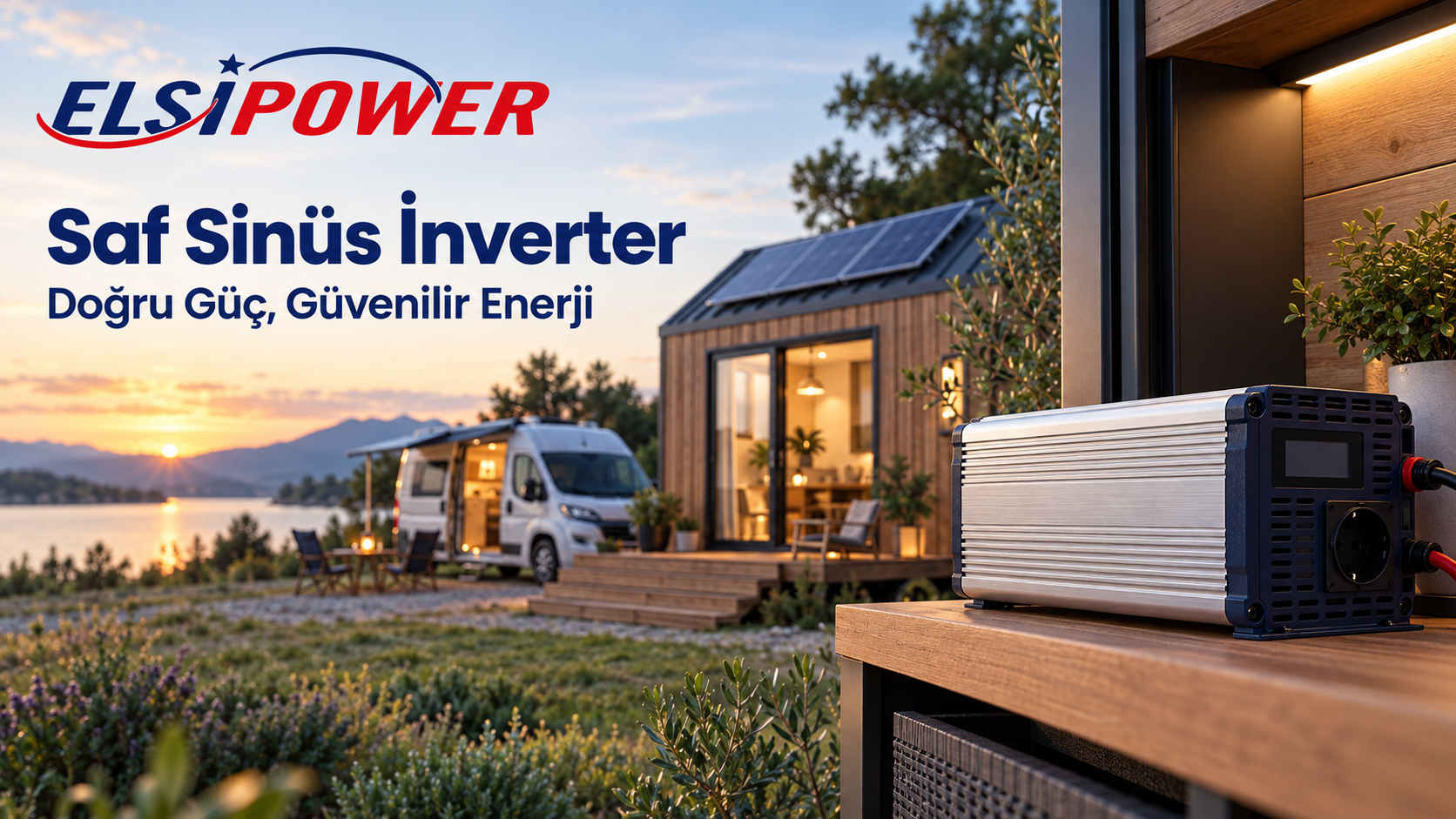
What Is an Inverter? Pure Sine Wave Inverter Guide
By: ELSIPOWER
A power inverter converts direct current (DC) from a source such as a battery into alternating current (AC) for compatible equipment. Whether you need electricity in a campervan, battery power in a tiny house or backup energy for selected business equipment, choosing a suitable inverter is a key part of the system.
Wattage alone is not enough. Pure sine wave output, continuous power, battery compatibility and required runtime need to be assessed together. This guide explains what an inverter does, where it is used and what to check before buying.
Explore ELSIPOWER inverter solutions or share your equipment list to discuss a suitable product.
What is an inverter and how does it work?
An inverter does not store energy or generate electricity from nothing. It changes the form of electrical energy, allowing energy stored in a battery to supply equipment that requires AC power. Runtime depends on usable battery energy and equipment consumption, rather than the inverter’s power rating alone.
For example, an inverter can supply a compatible television or small appliance from a campervan battery system. The output voltage and frequency, battery voltage and equipment power requirements must all match the application.
This article covers DC-to-AC power inverters used to supply equipment. Variable-frequency drives, which are also sometimes called inverters, control motor speed and have different selection requirements.
Why choose a pure sine wave inverter?
A pure sine wave inverter, also described as a true sine wave inverter, is designed to produce a sinusoidal AC output. This is relevant when connected equipment requires a suitable quality of AC supply.
Modified sine wave inverters produce a different waveform. With some equipment, this can cause noise, additional heating or compatibility issues. Check the equipment manufacturer’s power-supply requirements before choosing. Pure sine wave output does not mean every appliance will run: continuous capacity and starting performance still matter.
Where are power inverters used?
Campervans, motorhomes and mobile living
When choosing a campervan inverter, consider the television, computer, lighting and kitchen equipment as one system. Charging a phone and operating a coffee machine create very different power requirements. Identify equipment that remains on continuously so that limited battery energy can be managed effectively.
Tiny houses and off-grid cabins
For a tiny house or country cabin, daily energy use and required runtime are central to the design. A weekend property has different battery and charging needs from a full-time home. Refrigerators, water pumps and electric heaters should be assessed individually before selecting equipment.
Solar energy systems
A solar application requires an inverter suited to its system architecture. A battery-based off-grid system, a grid-connected solar inverter and a hybrid inverter do not all offer the same functions. A PV input, MPPT controller, battery charger or backup output during an outage is not included in every model. Check existing panel and battery specifications before selecting a product.
Boats, offices and field equipment
Marine applications require consideration of the installation environment and electrical system. Offices and mobile service vehicles need equipment matched to their connected loads. Transfer time also matters for sensitive equipment. Wattage alone cannot establish suitability for an application.
How to choose the right inverter
- List your equipment. Record the W or VA values on equipment labels and identify simultaneous loads. Watts and volt-amperes are not interchangeable for every load.
- Separate continuous power from surge power. A prominent high rating may refer only to short-term output. Compare the continuous load the inverter can support and the environmental conditions under which that rating applies.
- Check starting requirements. Refrigerators, compressors and pumps can demand more power when starting. How long the inverter can sustain its surge rating matters as well as the rating itself.
- Confirm battery compatibility. DC voltage, capacity and permitted battery discharge current must suit the system. For lithium batteries, check BMS limits. Where charging is included, verify the charging profile and any required communication compatibility.
- Plan runtime separately. A more powerful inverter does not automatically provide longer runtime from the same battery. Select battery capacity around energy consumption and the required operating period.
- Check installation and support requirements. Wiring, protection devices, ventilation and mounting must meet manufacturer requirements. Confirm warranty terms and the scope of after-sales support when requesting a quotation.
Discuss your inverter and battery requirements together with ELSIPOWER so that power conversion and stored energy suit the same application.
Inverter or UPS: which do you need?
An inverter’s core function is DC-to-AC conversion. An uninterruptible power supply (UPS) combines battery, charging and load-supply functions within a defined continuity and protection architecture. Some inverters also offer charging and automatic transfer, but these features are model-dependent and an inverter is not automatically a replacement for a UPS.
An inverter system may be appropriate for a campervan or off-grid living space. A server, computer or interruption-sensitive controller may require a UPS selected for the load’s tolerance. Share your application with ELSIPOWER to clarify the appropriate product type before purchasing.
What types of inverter are available?
Inverters differ in more than their power ratings. Their relationship with batteries, charging equipment and the grid also varies. Start with the intended application before comparing products: two inverters with the same wattage can be designed for very different systems.
Standalone battery inverter
Its core function is to convert DC energy from a suitable battery bank into AC output. Battery charging may be provided by a separate device. This arrangement can be considered where grid power is unavailable or mobile power is needed. Battery capacity and the charging method should be planned alongside the inverter.
Inverter/charger
An inverter/charger combines power conversion and battery charging. A suitable AC source can charge the battery, while the inverter supplies power from the battery when needed. Automatic transfer, source priorities and charging settings depend on the model. Confirm which functions are included before buying.
Grid-connected solar inverter
This type converts energy from solar panels into AC compatible with the electricity grid. Being connected to the grid does not mean it will continue powering household equipment during an outage. If backup power is required, check whether the system specifically supports that operating mode.
Hybrid inverter
The term hybrid is used for products capable of managing sources such as solar energy, batteries and grid power together. The name alone does not describe every feature. Supported batteries, panel inputs, backup output capacity and energy-management functions must be confirmed in the technical documentation.
Unsure which inverter type you need? Share your application with ELSIPOWER. Assessing your available energy sources and connected equipment together helps identify a suitable product category.
What inverter wattage do I need? A practical example
Start by adding the power consumption of equipment that will operate at the same time. Adding every appliance used at different times throughout the day can overstate the simultaneous requirement. Considering just one appliance can underestimate demand when other equipment is also switched on.
Suppose an 80 W television, a 60 W computer, a 15 W router and 45 W of lighting operate together. The running load in this example totals 200 W. This is a starting point only: actual consumption, VA requirements, transient demand and the inverter’s operating conditions must also be checked.
Adding a 1500 W kettle to the same simultaneous load increases the total to 1700 W. Saying that you will run “just a few appliances” does not establish that a small inverter will be sufficient. Which appliances run together matters more than their number.
For a motor-driven appliance such as a refrigerator or pump, starting demand must be assessed in addition to running power. Adding a fixed percentage is not suitable for every application; manufacturer information and load behaviour should guide selection. Discuss any planned future equipment at the same stage.
When comparing a 1000 W inverter, a 2000 W inverter or a larger unit, use the continuous output rating. These figures illustrate the selection process. Send us your equipment list to discuss available models suitable for your application.
How do you assess inverter battery runtime?
Inverter selection involves two separate questions: “Can it run this equipment?” and “For how long?” The first concerns power; the second concerns usable energy. Buying a higher-wattage inverter does not increase the energy stored in the battery.
For a simplified initial assessment, nominal battery energy is calculated by multiplying voltage by ampere-hour capacity. A battery labelled 12 V and 100 Ah therefore has a nominal energy value of 1200 Wh. Do not assume that all this energy will be available at the AC output under every operating condition.
Permitted depth of discharge, battery technology, load current, temperature, ageing and inverter losses affect actual runtime. The inverter’s own consumption also matters, particularly with small loads. For lead-acid batteries, the discharge duration used to specify capacity can affect the capacity available at higher currents.
As an illustration, suppose 600 Wh remains available on the AC side after losses and operating limits have been considered. A load averaging 200 W would then have an approximate runtime of three hours. This is a hypothetical calculation, not a runtime commitment for a particular battery or ELSIPOWER product.
For appliances that cycle on and off, such as refrigerators, daily energy consumption needs to be assessed separately from instantaneous inverter power. Sharing a photograph of the battery label and your required operating period helps establish a useful assessment.
Why does choosing the right inverter battery matter?
Even with an appropriate inverter, a battery bank unable to deliver the required energy and current may prevent the system from operating as expected. Battery suitability is not defined by its Ah value alone. Voltage, current limits, usage pattern and charging conditions need to be considered together.
AGM, gel and lithium batteries do not necessarily share the same charging settings or operating limits. For an inverter/charger, check compatibility with the battery manufacturer’s charging requirements. A claim of lithium compatibility does not by itself establish compatibility with every lithium battery.
If you plan to keep an existing battery, its age and condition also matter. A battery that has been unused for a long time or has lost capacity may not deliver the expected runtime with a new inverter. Discuss both battery and inverter requirements before purchasing to plan the complete system.
Common mistakes when buying an inverter
- Treating surge power as continuous power: A short-term high output does not mean the same load can be supplied continuously.
- Checking battery capacity alone: Battery voltage and permitted discharge current must also suit the inverter.
- Assuming every inverter accepts solar panels: Panel connection and solar charging must be explicitly supported by the product.
- Expecting every model to transfer like a UPS: Sensitive equipment requires a separate assessment of transfer time and supply architecture.
- Ignoring installation conditions: Temperature, ventilation, moisture and mounting space affect product selection.
- Leaving support terms unclear: Confirm warranty conditions, product support and installation responsibilities before purchasing.
Inverter efficiency and maintenance
Switching off unnecessary loads and monitoring energy use helps manage an inverter system effectively. In campervans and off-grid cabins, the operating time of high-consumption appliances directly affects the daily energy plan. Consider idle consumption and whether any power-saving mode is compatible with the connected equipment.
Keep ventilation openings clear and maintain the mounting clearances specified by the manufacturer. Dust accumulation, fan behaviour, unusual noises and recurring alarms should not be ignored. Inspection and maintenance intervals depend on operating conditions and manufacturer instructions.
Repeated shutdowns do not automatically indicate an inverter fault. Battery voltage, overload, temperature and connection conditions may also require assessment. Recording the model and displayed warning helps make technical support more effective.
What to prepare before buying an inverter
You do not need to know every technical term to start a product assessment. Equipment-label photographs, existing battery details and your required runtime provide a useful starting point.
- Application: campervan, tiny house, country cabin, boat or business.
- Equipment operating at the same time and its power ratings.
- Existing battery type, voltage and capacity.
- Required runtime and any available grid supply or solar panels.
These details help avoid selecting unnecessary capacity or buying a model unable to support the intended load. Contact ELSIPOWER for application-specific inverter selection and a quotation before placing your order.
Frequently asked questions about inverters
Are “inverter” and “invertör” the same device?
Yes. İnverter and invertör are Turkish terms used for a device that converts DC electricity into AC electricity. Its application and capabilities depend on the model.
Are pure sine wave and true sine wave inverters different?
These terms generally describe the same type of output waveform. When comparing products, also check the documented output characteristics, continuous power rating and surge duration.
What can a 1000 W inverter run?
An inverter genuinely rated for 1000 W of continuous output can power equipment whose combined running load and starting requirements remain within its limits. A television, router and lights may be suitable, but equipment labels, the VA limit and simultaneous use must be checked.
Can an inverter run a refrigerator?
An inverter can run a refrigerator when its continuous rating, starting capacity and battery system are suitable. Compressor starting demand may differ from normal running consumption. Assess the refrigerator model and inverter specifications together.
What size inverter do I need for a campervan?
There is no single correct wattage. Add up the equipment used at the same time, account for starting loads and check the battery system. High-power appliances such as kettles or coffee machines can significantly change both inverter and battery requirements.
How do I choose between a 12 V, 24 V and 48 V inverter?
The inverter’s DC input must match the nominal battery-bank voltage. A higher DC voltage means lower current at the same power, but the battery, charging system and wiring must be assessed together.
Does an inverter charge batteries?
A standalone inverter does not charge batteries. An inverter/charger can charge a compatible battery from a suitable AC source. Solar charging requires a compatible charge controller or a model with that function built in.
Can I connect solar panels directly to an inverter?
Not every inverter supports a direct panel connection. Do not connect solar panels directly to the DC input of a battery-input inverter. Direct connection requires a suitable PV input and panel voltage and current within the manufacturer’s limits; other systems use a compatible solar charge controller.
Will an inverter provide uninterrupted power during an outage?
That depends on the system design. Automatic transfer and transfer time vary between models. Computers, servers and control systems that cannot tolerate interruptions may require a UPS, which should be assessed separately.
How long will an inverter run on a battery?
The inverter’s wattage alone does not determine runtime. Usable battery energy, average load, conversion losses, battery condition and temperature all matter. Share the battery specifications and equipment list to request an assessment for your application.
What information should I provide before buying an inverter?
Provide the application, equipment list and power ratings, simultaneous loads, existing battery voltage and capacity, required runtime and any solar-panel details. This helps identify a suitable inverter and system configuration.
Choose an inverter for your application with ELSIPOWER
Explore ELSIPOWER’s pure sine wave inverter solutions and send us your application, equipment list and battery specifications. Let us assess product selection around your actual power requirements.
Send your equipment list and request a quotation for a suitable inverter.
Request product advice and a quotation
Phone: +90 212 210 75 51
Email: elsi@elsi.com.tr
Share