Endüstriyel Tesisler için UPS seçim rehberi
Fabrikalar İçin Kesintisiz Güç Kaynağı UPS Seçimi Rehberi
6 Temmuz
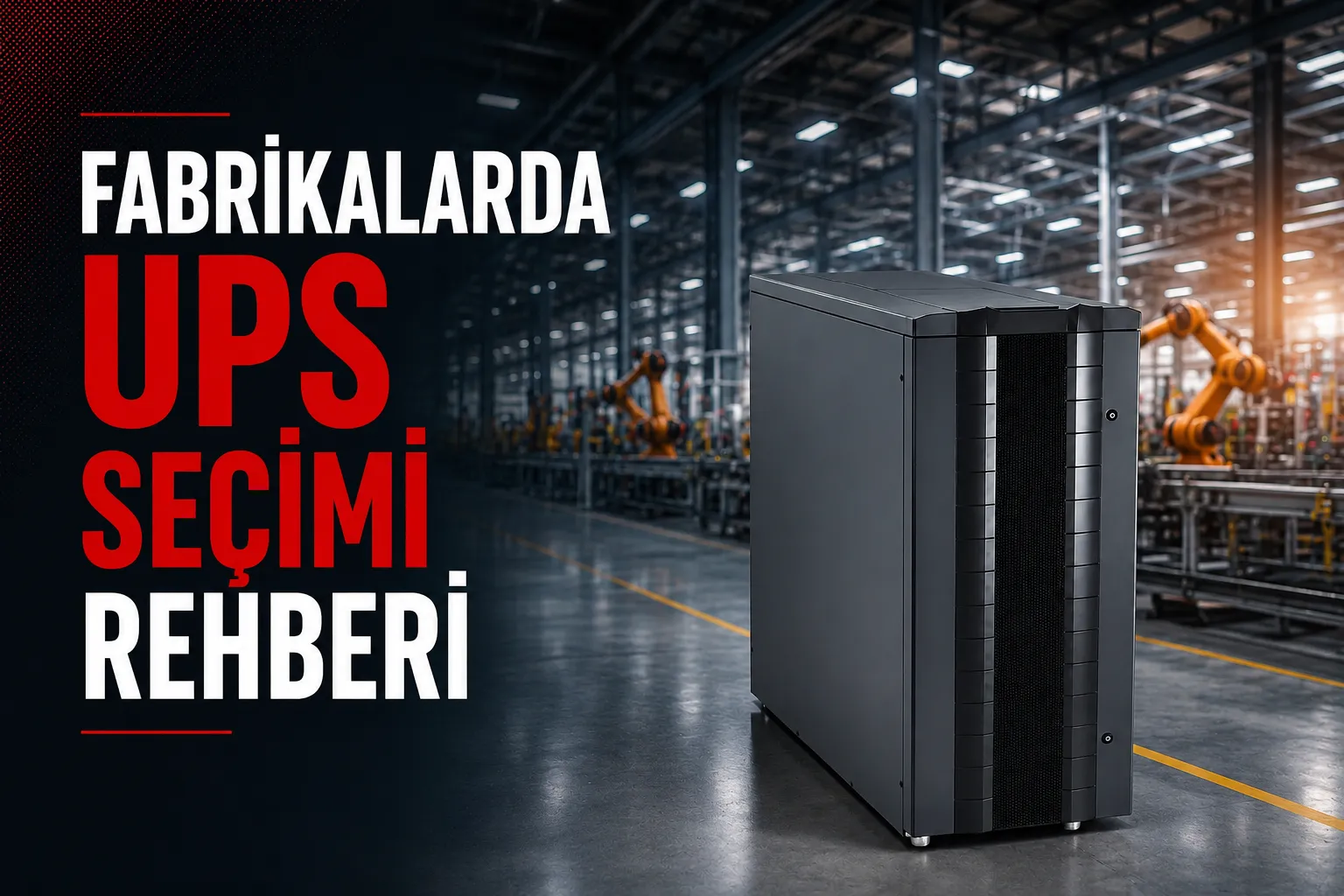
UPS Selection Guide for Factories and Industrial Facilities
In factories, production continuity does not depend only on machinery, automation systems or workforce efficiency. A stable and reliable electrical infrastructure is one of the most critical factors for safe and uninterrupted operation. For this reason, choosing the right uninterruptible power supply for factories is not just a device selection; it is a strategic decision directly related to production safety.
Power outages, voltage fluctuations, sudden voltage drops, harmonic distortion and grid-related problems can create serious risks for CNC machines, automation systems, robotic production lines, compressor control panels, PLC systems, server rooms and security systems. A properly selected UPS system helps protect factory operations by ensuring energy continuity.
As Elsipower, we provide uninterruptible power supply solutions from 1 kVA up to 3000 kVA for small production facilities, medium-sized factories and large industrial plants. You can contact us to determine the right UPS capacity for your facility or to receive technical service and maintenance support.
Phone: 0212 210 75 51
Email: elsi@elsi.com.tr
Why Do Factories Need a UPS System?
In industrial facilities, a power outage does not only mean that the lights go out. It can stop the production line, interrupt machine operations, cause automation systems to fail, lead to data loss and reduce product quality. In some industries, even a short interruption can result in significant financial losses.
Especially in factories with continuous production, even a few minutes of power interruption can create serious operational problems. Therefore, industrial UPS systems have become an essential part of energy security in manufacturing facilities.
What Should Be Considered When Choosing a UPS for a Factory?
When selecting a UPS for a factory, the decision should not be based only on the kVA value of the device. Load type, operating conditions, machinery structure, battery backup time, generator compatibility, future expansion plans and maintenance requirements should all be evaluated together.
1. Total Power Requirement Must Be Calculated
The first step in UPS selection is determining the total power requirement of the loads to be protected. All equipment that will be connected to the UPS should be listed, and the total power demand should be calculated. Future machinery additions and capacity increases should also be considered.
2. Load Type Must Be Analyzed
Not every load in a factory has the same electrical behavior. CNC machines, automation panels, security systems, servers, motor drives and sensitive electronic devices have different power characteristics. Therefore, load analysis is essential before selecting a UPS system.
3. Online UPS Systems Are Generally Preferred
In industrial facilities, online UPS systems are generally preferred. Online UPS systems provide continuously regulated and clean power to connected devices. This structure helps prevent voltage fluctuations and grid problems from reaching sensitive equipment.
4. Battery Backup Time Should Be Determined Correctly
The battery backup time of a UPS system should be determined according to the actual needs of the facility. In some factories, 5 to 10 minutes of backup time may be enough until the generator starts. In other facilities, longer backup time may be required to safely stop the production line.
5. Technical Service and Maintenance Support Is Important
Uninterruptible power supply systems are technical devices that require regular maintenance. Battery checks, fan inspections, connection controls, load tests and general system inspections should be performed periodically. For UPS technical service and maintenance needs, you can contact Elsipower.
For technical service and maintenance:
0212 210 75 51 - elsi@elsi.com.tr
Sample UPS kVA Selection Table for Factories
| Facility / Application Area | Recommended UPS Power |
|---|---|
| Small production workshops | 10 - 20 kVA |
| CNC machines and small production lines | 20 - 60 kVA |
| Medium-sized factories | 60 - 120 kVA |
| Automation-based production facilities | 120 - 250 kVA |
| Large industrial facilities | 250 - 800 kVA |
| Multi-line production factories | 800 - 1600 kVA |
| High-power industrial facilities | 1600 - 3000 kVA |
This table is prepared for general informational purposes. The correct UPS capacity should be determined after analyzing the actual load values, operating conditions and backup time requirements of the facility.
Why Are Modular UPS Systems Advantageous for Factories?
Today, modular UPS systems are increasingly preferred in large factories and facilities with growth potential. In a modular UPS structure, the system can be expanded with power modules. As the energy demand of the factory increases, new modules can be added instead of replacing the entire system.
Main Advantages of Modular UPS Systems
- Capacity can be increased according to future needs.
- N+1 redundant operation can be configured.
- Maintenance processes can be managed more flexibly.
- Initial investment cost can be optimized.
- Energy continuity becomes more reliable in large factories.
- In case of failure, intervention can be made on the related module instead of the entire system.
Especially in production facilities with expansion plans, modular UPS systems offer a scalable and long-term solution. Therefore, not only the current power requirement but also the future capacity increase of the factory should be considered.
The Importance of UPS Systems in Industrial Regions of Turkey
In many cities where manufacturing and industrial activities are concentrated in Turkey, the need for uninterrupted energy is very high. Especially in industrial cities such as Istanbul, Kocaeli, Bursa, Tekirdag, Izmir, Manisa, Ankara, Konya, Gaziantep, Adana, Mersin, Kayseri, Eskisehir, Sakarya and Malatya, UPS systems are critical for factories.
Factories operating in these cities should use properly sized uninterruptible power supply systems to protect production lines, automation systems, data centers, security infrastructure and sensitive electronic equipment.
Can UPS and Generator Systems Be Used Together?
UPS and generator systems are often used together in factories. While the generator provides long-term power support, the UPS system provides uninterrupted energy until the generator starts. In addition, the UPS helps deliver more stable power from the generator to sensitive devices.
However, UPS and generator compatibility must be planned correctly. Generator power, UPS capacity, load characteristics and generator start-up time should be evaluated together. An incorrectly selected generator or UPS system may cause unwanted interruptions in the production line.
Common Mistakes in Factory UPS Selection
- Choosing a UPS only based on price
- Ignoring future capacity increases
- Incorrectly determining battery backup time
- Selecting a device without analyzing the load type
- Ignoring generator compatibility
- Not creating a periodic maintenance plan
- Choosing systems without reliable service support
These mistakes may seem cost-effective in the short term, but they can lead to production losses, equipment failures and higher maintenance costs in the long term.
UPS Solutions for Factories with Elsipower
Elsipower provides uninterruptible power supply solutions for industrial facilities, production lines, automation systems, factory infrastructures and high-power energy requirements. With power options from 1 kVA up to 3000 kVA, the most suitable UPS system can be determined according to your factory’s needs.
If you would like to determine the right UPS capacity for your factory, get information about modular UPS systems or request technical service and maintenance support for your existing uninterruptible power supply, you can contact us.
Elsipower Contact:
Phone: 0212 210 75 51
Email: elsi@elsi.com.tr
Frequently Asked Questions
Which UPS system is preferred for factories?
Online UPS systems are generally preferred in factories because they provide stronger protection against voltage fluctuations, sudden power outages and grid-related problems.
How many kVA UPS does a factory need?
The required UPS capacity depends on the factory’s load, machinery structure, backup time requirement and future expansion plans. While 10 - 20 kVA may be sufficient for small facilities, large factories may require solutions up to 3000 kVA.
What is a modular UPS?
A modular UPS is a UPS system whose capacity can be increased with power modules. As the energy demand of the factory grows, new modules can be added to the system.
When should UPS maintenance be performed?
UPS systems should be checked regularly. Batteries, fans, connections and general system performance should be inspected as part of periodic maintenance.
Who can I contact for UPS technical service?
For uninterruptible power supply technical service and maintenance needs, you can contact Elsipower. Phone: 0212 210 75 51, email: elsi@elsi.com.tr
Conclusion
Choosing the right uninterruptible power supply for factories is a critical decision for production safety and energy continuity. A properly selected UPS system protects the production line, automation infrastructure, sensitive electronic devices and the overall energy security of the facility.
When selecting a UPS system, kVA capacity, battery backup time, load type, generator compatibility, service support and future growth plans should be evaluated together. Especially in large and growing production facilities, modular UPS systems provide significant advantages with their scalable structure.
As Elsipower, we provide uninterruptible power supply solutions from 1 kVA up to 3000 kVA for factories and industrial facilities. You can contact us for technical service, maintenance and correct UPS selection.
Phone: 0212 210 75 51
Email: elsi@elsi.com.tr
Share